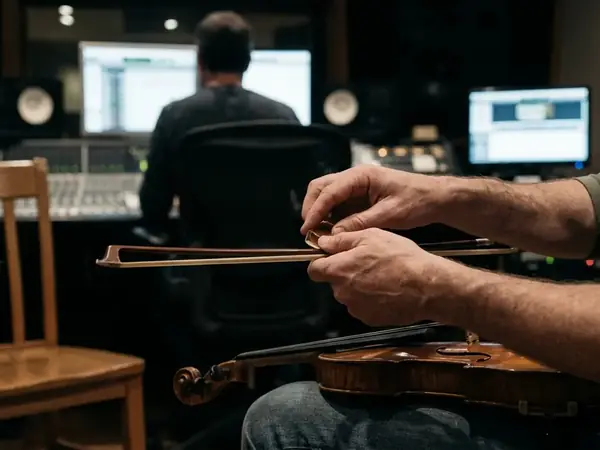
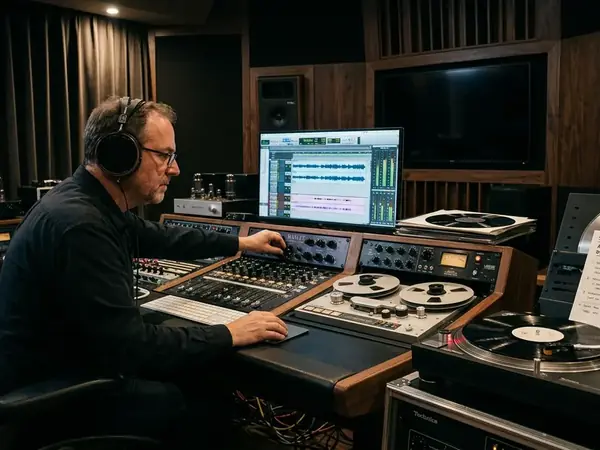
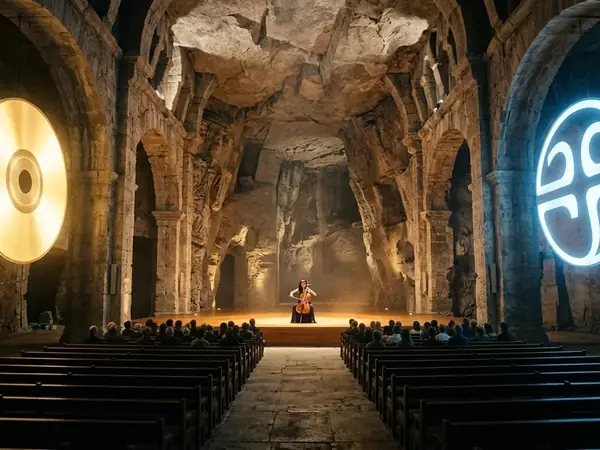
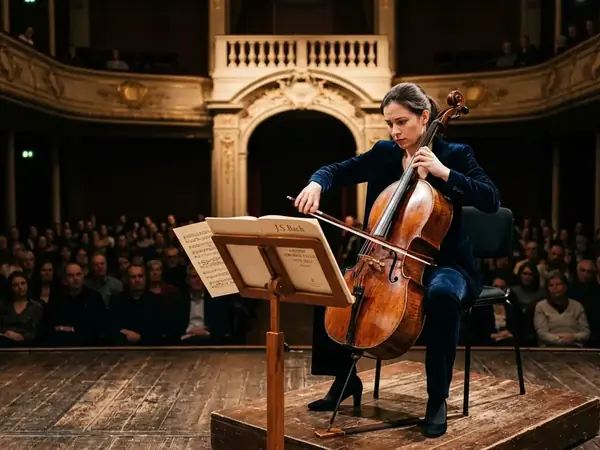
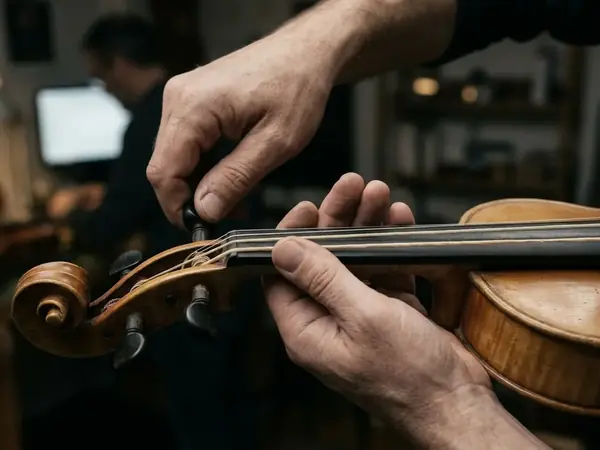
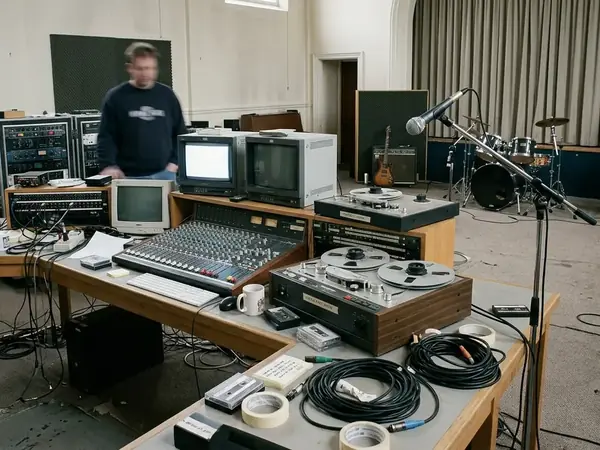
Historic violins reach the listener through several layers: carved wood, centuries of repair, a player’s technique, microphone choice, room acoustics, mastering, and playback. Any claim of tonal supremacy must separate those layers before assigning the result to age or pedigree.
The Golden Age remains a useful acoustic reference because Cremonese makers established forms that still govern violin construction. Yet a prestigious name alone cannot explain a fast attack, a warm lower register, or a tone that carries through a hall. Those qualities emerge from the interaction of material, geometry, setup, and use.
In this Article
- The Dawn of the Cremonese Masters
- The Modern Replication Dilemma
- Harmonic Complexity in High-Fidelity Audio
- Material Science and Acoustic Resonance
- Training the Audiophile Ear
- The Final Verdict on Tonal Supremacy
The Dawn of the Cremonese Masters
The historical boundary begins with construction. Andrea Amati, who lived circa 1505–1577, established the recognizable violin-family outline, including the arched spruce table and maple back. Those decisions created a coherent acoustic system: a light, stiff top responds to the bow, while the back and ribs help distribute vibration through the corpus.
Antonio Stradivari refined that system from the 1660s until 1737. His approximately 1690–1700 long-pattern violins commonly approached body lengths of 362–363 mm. Many later models returned to lengths near 355–358 mm. The change illustrates how a few millimetres can affect proportion, plate area, air volume, and the relationship among resonant modes.
Giuseppe Guarneri del Gesù produced his mature instruments chiefly between the late 1720s and 1744. His work and Stradivari’s later models offered distinct routes through the same structural problem: produce sufficient responsiveness under the bow while retaining tonal density and carrying power.
This period also belonged to a different pitch culture. A4 at 440 Hz was not a fixed standard in seventeenth-century Cremona; surviving regional evidence spans substantially lower and higher practices. Historic instruments now operate under modern string tensions, concert pitches, and setup conventions, so their present voices cannot be treated as untouched reproductions of their original musical environment.
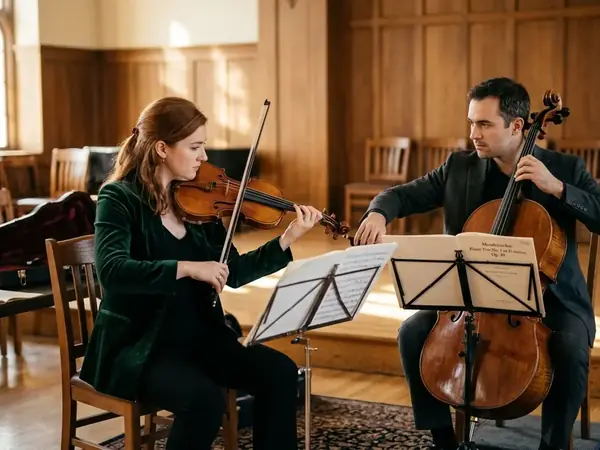
The Cremonese precedent endures because the underlying geometry proved adaptable. Violinist Arturo Delmoni and cellist Nathaniel Rosen work within a musical language whose projection, articulation, and phrasing still depend on that inherited family of forms.
The Modern Replication Dilemma
A contemporary copy may begin with optical scanning. The maker records the outline, arching, rib height, f-hole position, wear, and surface distortion. Workshop-grade systems can sample exposed surfaces at intervals around 0.05–0.20 mm. Computed tomography may then disclose plate thicknesses, internal repairs, and construction features hidden from direct view.
That degree of resolution produces an accurate geometric record. It cannot directly measure elastic modulus, internal seasoning checks, or longitudinal runout in the wood fibres.
Geometry Is Partial
A copied arching and graduation map can behave differently when the replacement spruce has another density, grain runout, cross-grain stiffness, or damping profile. Precision describes the shape; the selected wood determines how that shape moves.
A violin top commonly falls within a broad working thickness region near 2–3.5 mm, with deliberate local variation. Reproducing a thickness map to roughly 0.1 mm still leaves the maker with a new plate whose stiffness-to-mass relationship may depart from the original. Removing another shaving can shift a mode, yet preserving the scanned dimension may leave excess mass in a critical area.
Varnish introduces a second uncertainty. Synthetic varnishes can reproduce colour, gloss, and application consistency, but their acoustic effect depends on penetration, hardness, film thickness, and curing. A newly varnished replica may need several weeks of curing and repeated adjustments during its first 6–18 months. In that period, the bridge settles, seams experience humidity cycles, and the coating continues to harden.
The practical sequence therefore runs from scan to material selection, rough graduation, assembly, setup, listening, and adjustment. Laser accuracy gives the maker a disciplined starting point. Final voicing still requires judgment at the bench.
Harmonic Complexity in High-Fidelity Audio
On a revealing playback system, the distinction often appears first in the shape of a note rather than its pitch. The bow catches the string, the transient rises, upper partials establish texture, and the body releases energy into the room. Historic instruments are often valued for the apparent continuity of that sequence: articulation remains clear while the tone retains harmonic density.
A useful comparison separates four variables: source, performance, recording chain, and playback. The violin’s open G3 sits at approximately 196 Hz, while the cello’s C2 reaches approximately 65.4 Hz. A cello comparison therefore requires clean playback through roughly 65–130 Hz. Violin identity is often strongly affected by the 2–5 kHz region, where projection, bow noise, and microphone presence overlap.
A 24-bit, 96 kHz recording provides ample sampling headroom for violin transients and ultrasonic filtering. Moving from 44.1 to 96 kHz cannot recover harmonics, room cues, or attack information already lost through microphone placement or tape-generation loss.
Chain Before Character
Tonal rankings from archival releases apply to the recorded performance and its production chain. Microphone pattern, placement, hall decay, editing, equalization, tape condition, and mastering may outweigh construction in an uncontrolled comparison.
The distance of the main microphone makes the problem audible. Moving it from roughly 1 m to 3 m can soften bow attack and enlarge apparent warmth because the direct-to-reverberant balance changes. Two recordings of the same historic violin may consequently suggest different personalities: one immediate and wiry, the other rounded and spacious.
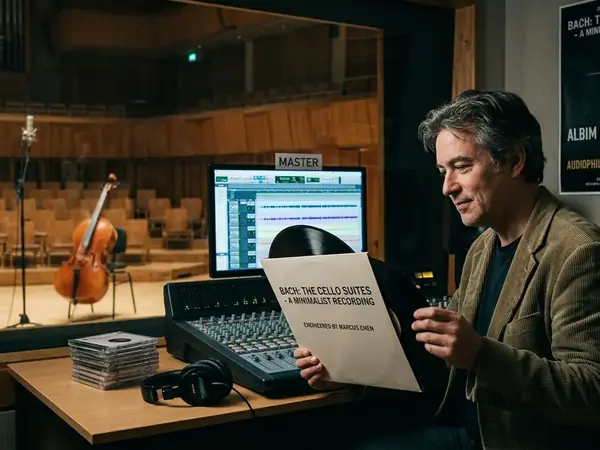
John Marks Records, as a publishing label concerned with natural string timbre, must preserve these distinctions rather than polish them into uniformity. A close recording helps listeners inspect articulation and overtone structure. A more distant pair conveys bloom and hall integration. Each perspective answers a different question about the instrument.
Material Science and Acoustic Resonance

Centuries of moisture cycling, oxidation, and gradual chemical change alter spruce and maple at the micro-cellular level. The tonal interpretation remains less settled than the aging mechanisms themselves. Old wood does not act in isolation; arching, thickness, repairs, varnish, strings, bridge, and soundpost all participate in the assembled response.
Humidity can produce faster audible changes than long-term aging. A violin is commonly maintained near 40–60% relative humidity. Movement beyond that range can change plate moisture, seam stress, bridge curvature, and short-term resonance. A dry plate may feel quick yet brittle, while excess moisture can accompany a softer response and altered setup.
Important assembled-body resonances often include an air mode near 270–300 Hz and body modes broadly around 430–560 Hz. Exact frequency and damping shift with plate stiffness, arching, f-hole geometry, setup, and environmental moisture. Readers pursuing the underlying theory can consult Stanford CCRMA material on acoustic resonance and material properties of string instruments.
Historic varnish recipes attract attention because a coating can influence damping and projection. The responsible question concerns degree. Varnish forms one mechanical layer in a coupled structure, and its contribution cannot be isolated reliably from wood properties and later intervention merely by listening to a finished instrument.
Cremonese makers worked without algorithmic frequency analysis. They could assess mass, flexibility, arching, and the pitch or character produced when a plate was tapped. This intuitive tap-tuning joined sensory evidence to repeated construction practice.
Setup remains equally sensitive. A soundpost may be moved by increments well below 1 mm, changing local stiffness and the balance among brilliance, bow resistance, and lower-string response. That adjustment can transform the listener’s impression without changing the corpus itself.
Training the Audiophile Ear
The strongest listening test begins with restraint. Solo violin sonatas and unaccompanied cello movements expose attack, register changes, bow pressure, and decay without an orchestra masking the instrument’s timbre.
1. Choose Comparable Passages
Select excerpts lasting 30–60 seconds. Match repertoire, phrasing density, and register as closely as the recordings allow. Alternate samples within 10 seconds; longer delays allow musical memory and performance preference to blur the tonal comparison.
2. Match Playback Level
Set levels within approximately 0.2–0.5 dB at the listening seat. A slightly louder sample can appear more detailed, extended, and dynamically alive even when its spectral behaviour is similar. Level matching removes one of the most persuasive sources of false preference.
Level Before Judgment
Do not adjust volume to make a quieter master feel equally exciting during the passage. Match first, leave the control untouched, and record the impression only after both excerpts have played.
3. Listen in Three Passes
- Attack and articulation: Follow the instant the bow grips the string. Note whether the onset sounds quick, glassy, rounded, blurred, or accompanied by excessive bow noise.
- Lower-register definition: On violin, hear whether the G string retains pitch centre beneath its warmth. On cello, check whether the C string remains textured through the 65–130 Hz region instead of becoming a generalized bass swell.
- Decay and space: Track the end of sustained notes. Separate the instrument’s natural release from reverberation added by the hall, microphone distance, or mastering.
Limit each pass to 15–20 minutes and pause for at least 5 minutes before continuing. Short sessions reduce fatigue and keep the listener focused on one acoustic property at a time.
4. Change One Variable
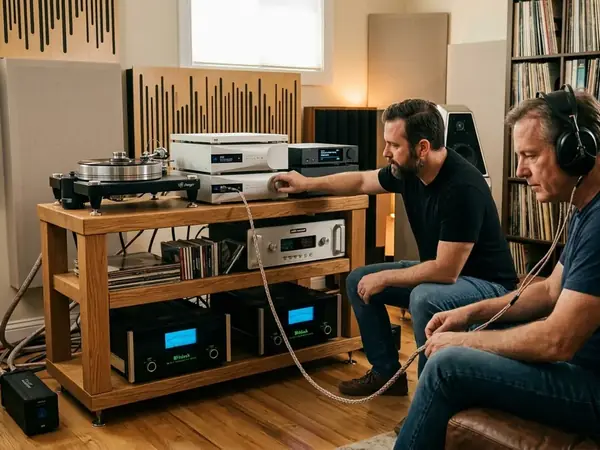
Repeat the comparison through speakers and headphones if both are familiar. Speakers reveal room interaction and low-frequency extension; headphones expose edits, close-microphone bow texture, and channel-specific ambience. The preferred presentation may change, which itself identifies how strongly playback conditions shaped the first judgment.
The Final Verdict on Tonal Supremacy
Cremonese violins and cellos remain historically central because players, teachers, collectors, and recording engineers have treated them as reference instruments. Their legacy rests on adaptable construction, distinctive examples, and centuries of musical use.
Age alone offers no guaranteed hierarchy. A 300-year-old violin may contain a modern neck graft, replacement bass bar, edge repairs, soundpost patches, and retouched varnish. Its current voice combines the original corpus with later workmanship. A prestigious antique in poor adjustment can sound slow, nasal, or uneven, while a well-set-up modern violin can deliver cleaner attacks and stronger projection.
Live assessment also requires distance. Near-field response can be judged at roughly 3–5 m, then carrying power at 12–20 m. An instrument that sounds rich under the player’s ear may lose harmonic balance across the room; another may seem lean nearby and become coherent in the hall.
Recordings add their own verdict. A historic instrument heard through sympathetic microphone placement can preserve transient speed, lower-register warmth, and a natural decay that makes its reputation immediately plausible. Change the room or production chain, and the apparent advantage may move.
When historic colour and modern clarity point toward different recordings, which quality will decide what earns a permanent place in your listening library?