The Quest for Perfect Sound Reproduction
I remember unboxing my first certified audiophile compact disc in the late 1980s. The standard aluminum pressings of the era often looked cloudy under harsh light. Listening to them was sometimes worse. Commercial compact disc listening had entered the classical-audiophile mainstream in the early 1980s, establishing the Red Book disc as the baseline format for 16-bit, 44.1 kHz two-channel playback. Critical listeners quickly noticed a harshness in the upper registers of string instruments. We wanted better.
By the mid-1990s, premium CD labels and specialist reissue programs began using heavier quality-control language around source tapes, glass mastering, and reflective layers to distinguish their audiophile discs from mass-market aluminum pressings. SACD entered the market at the end of the 1990s as a high-resolution optical format aimed at listeners who wanted more than the Red Book CD layer could encode.
The Anatomy of a Gold CD: Material Superiority
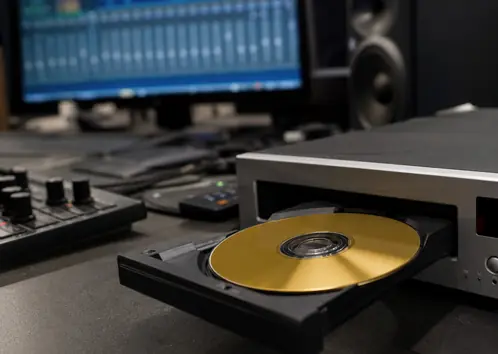
A Gold CD carrying standard CD audio still uses 16-bit linear PCM at 44.1 kHz, two channels, and the exact same basic playback path as an aluminum compact disc. The difference lies in the physical manufacturing and the studio care behind it. The reflective layer is typically 24-karat gold rather than aluminum. Gold is chemically resistant to oxidation. This addresses long-term corrosion mechanisms that can appear as edge degradation, pinholes, or reflective-layer failure in poorly protected aluminum discs.
A standard compact disc is read through an about 1.2 mm polycarbonate substrate by an infrared laser around the 780 nm class. The player reads pit-and-land transitions rather than the metal layer as music directly. Optimal reflectivity reduces the error-correction workload.
The audible benefit is most plausible when the gold pressing is tied to a dedicated mastering pass from first-generation or low-generation analog sources. Labels like John Marks Records prioritize these dedicated mastering passes. This is especially true for string recordings where upper-midrange glare and tape hiss handling are easy to hear. I have always preferred the warmth of a well-mastered Gold CD for solo cello works, such as those performed by Nathaniel Rosen.
The Architecture of SACD: Direct Stream Digital

SACD is defined under the Scarlet Book family of specifications and was introduced as a successor-class optical audio format around 1999. The common SACD high-resolution stream is DSD64. This is a 1-bit signal sampled at 2.8224 MHz, which is 64 times the 44.1 kHz sampling frequency used for standard CD audio.
Direct Stream Digital relies on aggressive noise shaping. It maintains very low noise through much of the audible band, with rising ultrasonic noise above the main hearing range that must be handled by the playback filter and analog stage. Understanding digital audio sampling and signal processing helps clarify why this approach differs so radically from Pulse Code Modulation.
SACD can carry stereo and multichannel programs. Hybrid discs add a separate Red Book-compatible layer so a conventional CD player can read the CD program while an SACD player accesses the DSD program. A hybrid SACD may contain different mastering on the CD layer and the DSD layer, so comparing the two layers does not always isolate format differences.
Direct Comparison: Resolution, Mastering, and Playback
Listening comparisons revealed distinct playback consequences for each format. A Gold CD can be played in ordinary CD transports, computer optical drives that support audio extraction, and legacy CD players from the 1980s onward. The audio layer remains Red Book-compatible.
The high-resolution layer of an SACD requires an SACD-capable player or transport. A standard CD player reads only the Red Book layer on a hybrid disc and cannot access the DSD layer. Many universal disc players route SACD through analog outputs or restricted digital paths. Some SACD-capable players convert DSD to PCM internally for volume control, bass management, or room correction, changing the expected signal path.
Summary: Playback Consequences
- Gold CD: For solo violin recordings featuring artists like Arturo Delmoni, string quartets, and chamber orchestra recordings, advantages are usually heard as stable tone color and reduced digital edge.
- SACD: Advantages are most often heard as longer hall decay, finer spatial separation, and less congested massed strings.
Scope and Limitations: Why the Master Matters Most
A high-resolution DSD transfer of a second- or third-generation tape with rolled-off treble, print-through, or overload remains limited by those tape conditions. A plain aluminum CD sourced from an excellent early digital master can outperform a premium Gold CD made from a bright or compressed remaster. A carefully mastered Red Book disc can outperform a poorly equalized SACD release in perceived tonal balance. This is especially noticeable on violin and viola where a small upper-midrange lift can make the instrument sound steely.
Room effects can mask format differences. Strong early reflections from bare sidewalls, untreated glass, or a listening chair close to the rear wall may dominate the perceived soundstage before disc resolution becomes the limiting factor. Human hearing sensitivity falls sharply at ultrasonic frequencies, so claims based solely on SACD response beyond about 40 kHz should be treated as engineering capacity, not automatic audibility.
Note: The Limits of Format Superiority
Format superiority claims become unreliable when playback levels are not matched within roughly 0.1 to 0.2 dB or when the Gold CD and SACD come from different mastering sessions.
Implementation: Choosing the Right Format for Your System
First verify whether the player explicitly reads the SACD high-resolution layer. A tray that accepts the disc physically does not provide guaranteed playback of the high-resolution layer if it only outputs the hybrid CD layer. Check whether the DAC accepts native DSD, DoP, or PCM only. Many two-channel DACs from the 2010s and early 2020s list DSD64 support separately from PCM rates such as 24-bit/96 kHz or 24-bit/192 kHz.
Quick Tip: Disc Maintenance
- Store optical media vertically in inert jewel cases or archival sleeves.
- Keep discs away from direct sunlight and high heat.
- Avoid paper sleeves that abrade the label side or trap grit against the playing surface.
For a classical library, prioritize releases with documented source information, minimal dynamic processing, and credible mastering notes before paying a premium for the physical format. Proven mastering chains yield better results than format specifications alone—the master tape always dictates the ceiling.