In this Article
- Translating Literature into High-Fidelity Audio
- Timeless Acoustics in the Emerging Information Age
- Selecting the Instrumentalists: Delmoni and Rosen
- The Implementation of Purist Recording Techniques
- Results: The Passacaglia as a Musical Recapitulation
Translating Literature into High-Fidelity Audio
Refusing the obvious translation
The first disciplined choice in The Glass Bead Game CD was not to turn Hermann Hesse's novel into plot music.
That restraint matters. Hesse's late work, recognized through the 1946 Nobel Prize in Literature, does not offer a simple sequence of scenes waiting for illustration. Its musical potential sits in discipline, recurrence, intellectual play, and the tension between abstraction and sensuous experience. A literal score would flatten that tension. A better recording asks the listener to hear form thinking through sound.
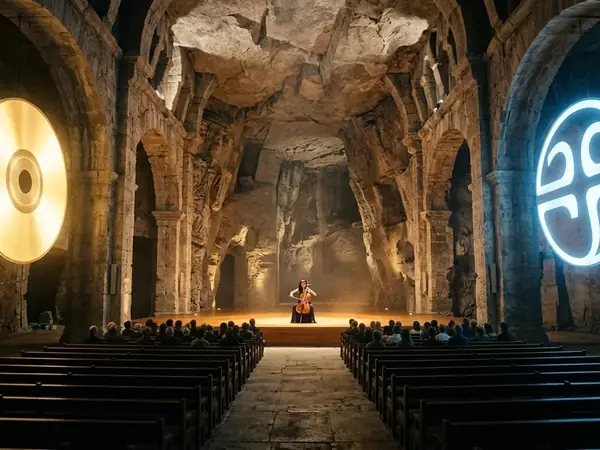
For John Marks Records, the publishing label context makes the choice unusually demanding. The disc cannot hide behind literary prestige. It has to stand as a compact disc that an attentive listener can place in a serious two-channel system and judge by tone, space, and time.
Turning a conceptual game into acoustic evidence
The core challenge is almost paradoxical: capture the essence of a purely conceptual game using two physical acoustic instruments, each producing air movement, bow friction, body resonance, and decay.
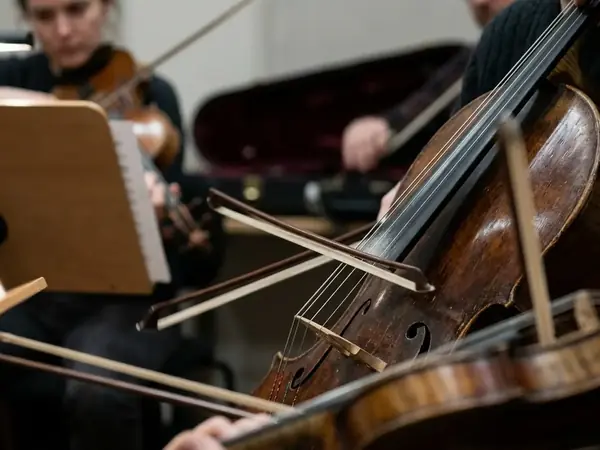
The violin and cello make that paradox useful. The cello can reach down to C2, around 65 Hz, while the violin's open E string sits at E5, around 660 Hz. Between those poles lies a practical check on fundamentals, overtones, bow noise, harmonic extension, and the human instability that gives string playing its pressure.
Summary: The adaptation succeeds only if the listener hears intellectual structure through physical performance, not through narrative illustration.
The compact disc baseline
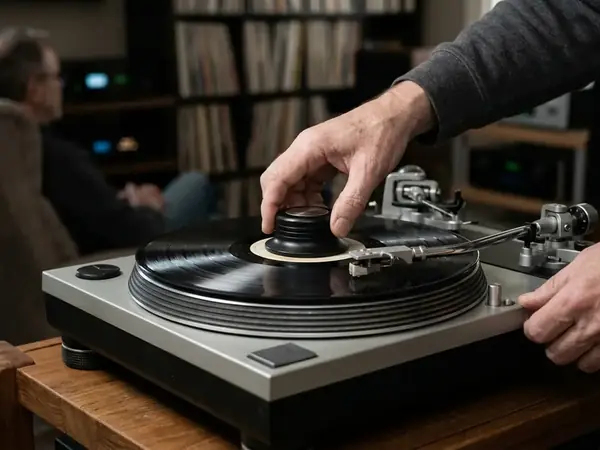
An audiophile compact disc begins with limitation, not luxury. Red Book CD gives the producer 16-bit linear PCM at the standard 44.1 kHz in two channels. There is no surround field to enlarge the stage, no high-resolution container to soften poor gain choices, and no multichannel spectacle to distract from a hard violin entrance.
That format sets the article's central question: can a standard compact disc carry a literary idea, a chamber performance, and an audiophile standard at the same time? In this case, the answer depends less on volume and more on proportion.
Timeless Acoustics in the Emerging Information Age
1997-1998 as listening context
The production window, 1997-1998, gives the project its cultural tension.
Physical media still mattered. Compact discs remained primary high-fidelity sources, especially for listeners who treated string tone as a test of midrange naturalness. At the same time, networked information was accelerating. Consumer and institutional ISDN access commonly used 64 kb/s per B-channel, or 128 kb/s when two channels were bonded. Uncompressed stereo CD audio, by contrast, runs at a little over 1,400 kb/s.
The comparison is not nostalgia dressed as engineering. It clarifies why this disc feels deliberately paced. The late-1990s listener could feel data speeding up around the listening room, while a violin and cello still required patience, breath, and sustained attention.
Information speed versus musical return
A fast network rewards transfer. A Passacaglia rewards return.
That difference gives the recording its structural anchor. The Passacaglia form relies on recurrence over variation, so the ear keeps checking the same ground under changing pressure. Bow weight shifts. Vibrato widens or narrows. Articulation tightens. Harmonic tension gathers around material the listener has already met.
This is where the literary association becomes concrete. Hesse's game is not imitated by a theme assigned to a character. It is recast as a musical habit of mind, one that lets repetition become inquiry.
Note: The late-1990s digital backdrop does not make the disc anti-technology. It makes the recording a test of whether technology can preserve deliberation rather than only accelerate delivery.
Why the Passacaglia fits the case study
Among classical forms, the Passacaglia gives engineers and listeners a rare advantage: comparable material returns often enough to expose change. That makes it useful for judging both interpretation and capture.
On repeated returns, the ear can compare the violin's upper register without mistaking brightness for insight. It can track the cello's bass entries without confusing size with authority. In a lesser recording, each return becomes another event. In a stronger one, each return becomes evidence.
Selecting the Instrumentalists: Delmoni and Rosen
The exposure risk of a purist duo
A purist string recording leaves very little cover.
There is no orchestral blending to round the edges. There is no studio layering to thicken a thin phrase. Heavy post-production can correct some problems, but it usually takes payment in air, touch, or spatial coherence. In duo repertoire, pitch drift appears quickly, especially in sustained double-stops, unison approaches, and resolving intervals where small cent-level deviations become obvious.
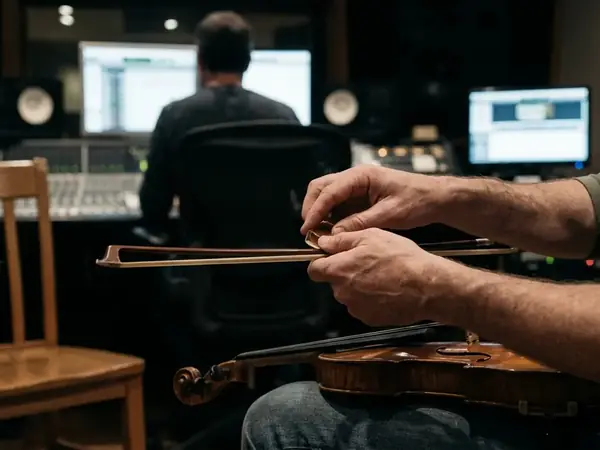
That exposure shaped the choice of musicians. Arturo Delmoni and Nathaniel Rosen were not selected merely as names; they were selected for how their tones would survive scrutiny.
Arturo Delmoni and the upper architecture
Delmoni's violin role carries the disc's visible edge. The violin open strings run G3-D4-A4-E5, and the instrument's upper harmonics can either illuminate the room or turn brittle under close, anxious recording.
His suitability lies in tonal concentration. The line can project without becoming metallic, and the bow can speak clearly without forcing the microphone to exaggerate every strand of hair against string. That distinction is crucial on revealing systems, where treble energy often masquerades as detail.
In a comparison of styles, the preference here is plain: a violin tone with inner density serves Hesse's abstraction better than a glassy showpiece tone. The audience for this disc is not looking for speed alone. It is listening for disciplined intensity.
Nathaniel Rosen and the lower register
Rosen supplies the acoustic foundation. The cello's open strings run C2-G2-D3-A3, placing him below the violin but never outside the conversation.
His résumé includes a major Moscow-based international competition win in 1978, a detail that matters because exposed duo repertoire rewards security under pressure rather than studio-only polish. A low entry must arrive with pitch, weight, and timing already settled. If the cello blooms artificially, the Passacaglia loses its spine. If it thins out, the violin floats without ground.
Quick Tip: When auditioning this kind of duo recording, start with the cello's first strong bass entries. If they sit as a physical source below the violin rather than a centered mono smear, the engineering claim has real support.
The Implementation of Purist Recording Techniques
Letting the room act as part of the instrument
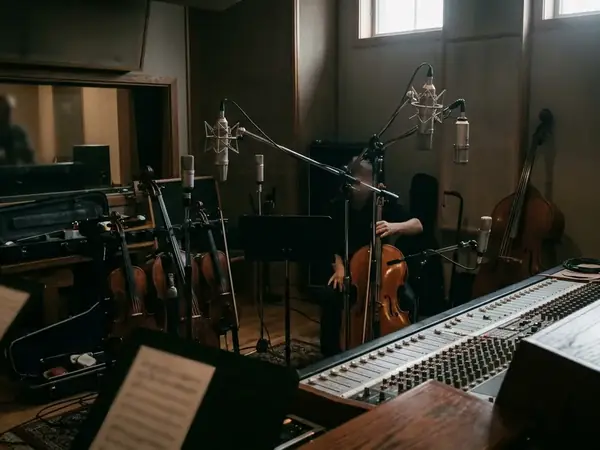
The engineering decision begins with a simple principle: the room is not background. It is part of the instrument.
For violin and cello, maximum closeness rarely gives maximum truth. Too near, and the microphone catches rosin, finger noise, and bow attack before the wooden bodies have organized those sounds into tone. Too far, and articulation loses its edges. The useful distance sits between presence and integration.
For a two-instrument purist session, the practical placement zone is usually a main stereo pickup roughly one and a half to three meters in front of the players, high enough to reduce floor emphasis while keeping bow articulation intact. That range is not a recipe; it is a working corridor.
A working method for placement
- Establish the players' natural balance. Place the violin and cello where they can hear each other without forcing projection toward the microphones.
- Set the main stereo pickup before considering spot support. If the main image cannot carry the duo, extra microphones will mostly document the problem.
- Listen for decay after phrase endings. Room tone should remain audible without swallowing articulation.
- Check loud passages for image stability. If the picture collapses when both instruments intensify, the recording no longer supports a purist claim.
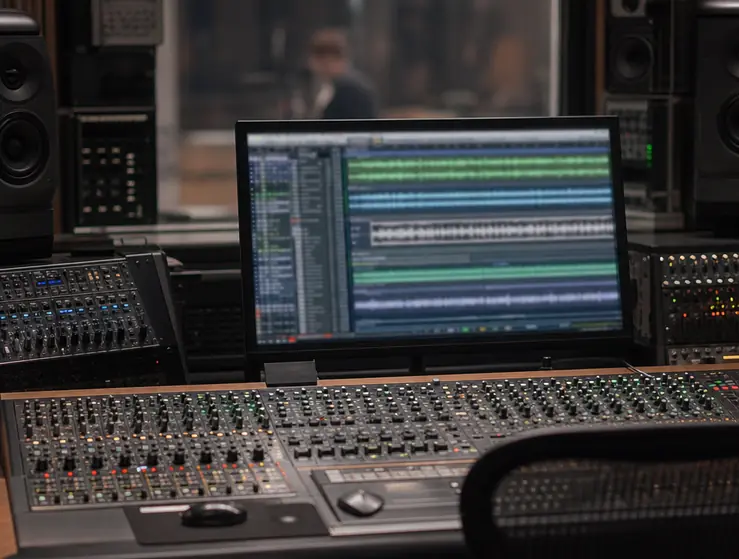
Creative variation can still live inside that method. A slightly higher pickup can reduce floor weight and clarify violin height. A modest shift toward the cello can restore foundation if the violin dominates the room. The mistake is to solve balance entirely at the console when the better fix is often a chair moved by a few inches.
Mastering within the compact disc limit
The CD medium's theoretical 16-bit dynamic range is approximately 96 dB. That sounds generous until the engineer tries to preserve low-level decay, breath-space between phrases, and transient peaks without aggressive normalization.
Workshop experience shows that string recordings suffer when the mastering stage treats quietness as unused space. The Passacaglia needs silence with memory in it. Push the level too hard, and the room shortens. Clean the noise too aggressively, and the air after the bow disappears.
These listening inferences hold most firmly for the original compact disc master; later remastering, level-shifted files, or lossy streaming copies can change the room decay and transient evidence under discussion.
Results: The Passacaglia as a Musical Recapitulation
What the final disc asks of the listener
The finished CD belongs to a specific reception world: late-1990s through early-2000s two-channel listening, when compact discs still carried serious audiophile authority and string tone exposed weak systems quickly.
On a properly set two-speaker system, the useful condition is a stable center image, with the speakers and listener forming an approximate equilateral triangle. Domestic rooms commonly place speakers about two to two and a half meters apart, though room treatment and reflection patterns matter as much as geometry.
The disc rewards that care. It does not shout its engineering. It lets the Passacaglia accumulate meaning through repeated contact.
Three audible zones of reference value
- Violin upper harmonics without glassiness. A bright system may make the violin sound detailed while actually exaggerating bow hair and upper harmonics. That is treble glare, not recording resolution.
- Cello fundamentals without artificial bloom. The cello should occupy a believable lower body, not a swollen bass halo detached from Rosen's bowing.
- Room decay after phrase endings. The acoustic space should remain perceptible after the players release a phrase, rather than vanishing as if clipped by noise reduction.
These zones make the disc useful beyond admiration. They give equipment owners a way to separate musical beauty from playback flattery.
Recapitulating Hesse through sound
The Passacaglia succeeds here because recurrence becomes audible thought. The listener hears return, pressure, adjustment, and consequence. That is close to the novel's intellectual atmosphere without reducing literature to decoration.
Context still matters. In a small reflective room, the same compact disc can appear more forward and less spacious than it does in a damped listening room, so reception claims should separate disc character from room contribution.
The enduring legacy of The Glass Bead Game CD rests on that balance. It is a literary case study, a chamber performance, and a compact disc engineering test, but its most refined achievement is simpler: it lets violin, cello, room, and form argue in the same language.