The Acoustic Foundation of String Chamber Music
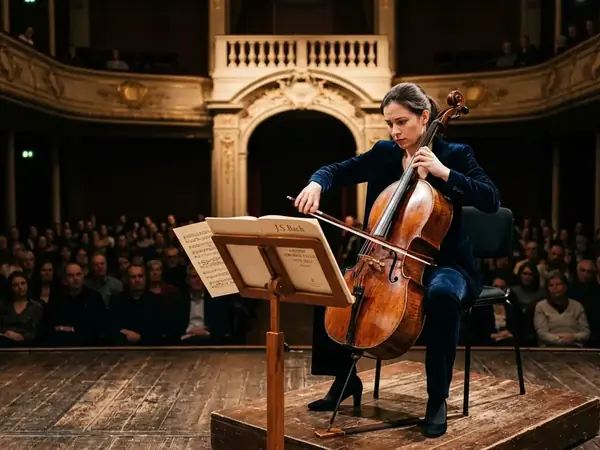
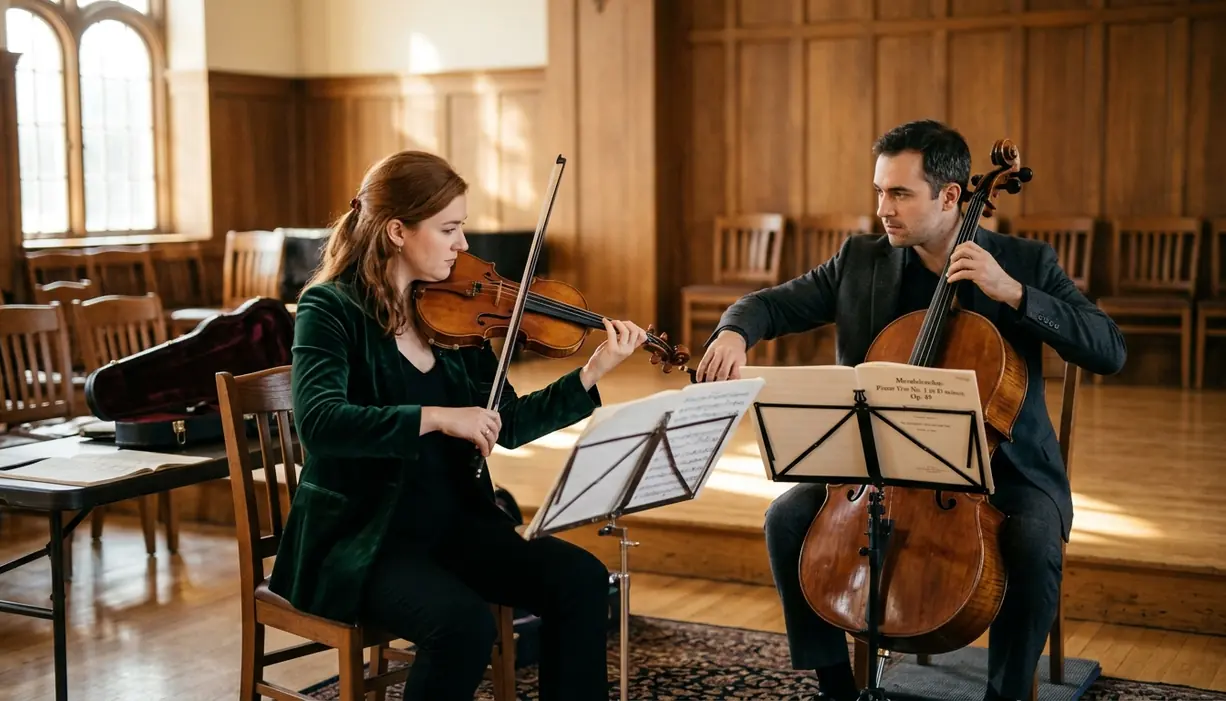
The pairing of violin and cello is too often described as a contrast of high against low. That framing misses the point. What actually distinguishes the duo is how each instrument occupies physical space, not merely where it sits on the staff.
As working figures based on creative process, the numbers explain the asymmetry. A modern violin vibrates a string length of about 33 cm, while a full-size cello works with something near 70 cm. That difference is why the cello speaks naturally around C2 at roughly 65 Hz and the violin begins its open range at G3, near 196 Hz. The gap is not stylistic. It is built into the wood and the string.
This way of writing for two distinct voices matured slowly. It grew out of late-18th-century salon and domestic ensemble practice, then sharpened through 19th-century concert chamber writing, where the string parts were increasingly treated as individual speakers rather than as a thinned-out orchestra.
The central problem is acoustic before it is interpretive. The violin's upper register tends to project its energy in the 2 to 6 kHz region, while the cello's body resonance and fundamental support live mostly between about 65 and 250 Hz. Balancing projection against resonance is the recurring engineering question of this repertoire.
Frequency and Timbre: The Physics of Strings
The same written interval can read as stable, exposed, or congested depending on register and bow contact. Frequency behavior and musical role are not the same thing, and separating them is the first step toward recording the pair honestly.
Violin Radiation and Directionality
Violin radiation becomes noticeably more directional as its upper harmonics climb past roughly 1.5 to 2 kHz. A small shift in player angle or microphone height is enough to make the instrument sound either silvery and present or thin and off-axis. This is one reason a recordist cannot treat microphone placement as a fixed recipe. The instrument's high end is, quite literally, pointed.
The Cello as Acoustic Anchor
The cello's fundamentals from C2 to A3 span about 65 to 220 Hz, yet much of its perceived identity comes from harmonics and body energy reaching through roughly 250 to 800 Hz. Its lower frequencies behave omnidirectionally, which is precisely why it functions as the room's anchor. You do not aim a cello the way you aim a violin.
The overlap matters most around 200 to 660 Hz, where violin lower-register fundamentals meet cello upper harmonics. Excessive room reflection in this band blurs counterpoint and collapses two independent lines into one thick texture. For readers who want the underlying mechanics, this physics of string instrument acoustics resource is a useful companion.
Transients add another layer. Pizzicato attacks produce a sharp front edge within roughly 10 to 35 ms, and spiccato relies on a fast contact-and-release cycle that exposes microphone placement and compression artifacts far more than sustained arco playing.
Harmonic Interplay and Compositional Techniques
Compositional technique behaves like an acoustic control system. Contrary motion clarifies registral identity, double stops inflate apparent ensemble size, and sustained cello writing supplies the harmonic floor that lets the violin breathe.
Contrary Motion as Spatial Clarity
Contrary motion works best when the violin rises through A4 to E5, about 440 to 660 Hz, while the cello descends through D3 to C2, roughly 145 to 65 Hz. The ear receives widening register and diverging radiation behavior at the same instant. The two voices separate spatially, not just melodically.
Double Stops and Sympathetic Resonance
One instrument sustaining a dyad while the other moves can suggest three or four sounding voices. The illusion strengthens when stopped pitches excite open-string neighbors, such as violin D4 near 295 Hz or cello G2 near 100 Hz. A violinist of Arturo Delmoni's discipline can summon a quartet's worth of texture from a single bow with this technique.
In strict duo writing, the absent viola is most conspicuous in the 220 to 500 Hz middle band, where its C-string and G-string warmth would normally soften the transition between cello resonance and violin clarity. Composers either accept that gap or coax the cello upward to bridge it.
Cello low-register decay in a supportive chamber room can remain musically perceptible for roughly 1 to 2.5 seconds, giving the violin enough resonance to sustain or resolve without sounding harmonically stranded.
The Limitations of Standard Recording Methods
The most useful question in evaluating a recording technique is simple: what changes when the listener moves from a hall seat to a microphone capsule? Most failures trace back to that displacement.
Close-miking is the central risk. Microphones placed about 15 to 40 cm from a violin or cello overstate bow hair noise, fingerboard clicks, and f-hole radiation while underrepresenting the integrated tone that only forms roughly 1.5 to 4 m from the players. The capsule hears mechanism; the listener wants music.
Phase Cancellation in the Midrange
When two microphones capture the same midrange event with a path-length difference near 34 cm, the arrival-time offset approaches 1 ms, which can produce a first comb-filter cancellation around 500 Hz. That is squarely inside the violin-cello overlap band. The result is counterpoint that thins out for no apparent musical reason.
Compression and the Lost Bow Attack
Compression attack times below roughly 10 ms shave the leading edge from bow attacks. Ratios above 3:1 are often enough to make spiccato and accented détaché feel smaller, even as the average level grows more consistent. The recording becomes louder and less alive at once.
Note: The tactile woodiness of cello and lower violin resonance lives around 120 to 350 Hz, but that same range is where small-room modes and proximity buildup turn a recording boxy rather than resonant. Watch it carefully.
Consider a familiar failure case: a technically expensive close-miked session can still make a duo sound smaller than it did in the room if the direct signals are panned apart and the shared early reflections never reach the capsules.
High-Fidelity Capture: Microphones and Room Acoustics
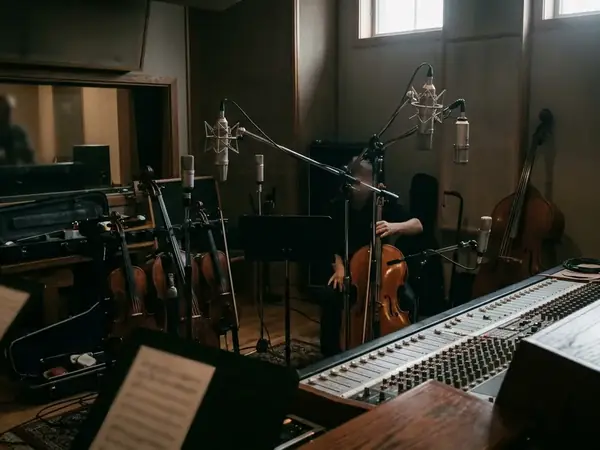
Violin-cello balance depends on timing integrity and room proportion, which is why minimalist arrays remain the preferred capture method. The practical path is to establish the main stereo image first, then decide how much room to invite in.
Choosing the Main Array
A Blumlein pair uses two figure-8 microphones mounted coincident at 90 degrees, frequently placed roughly 2 to 3.5 m in front of the duo and 1.7 to 2.4 m high for a seated chamber perspective. Because the capsules share a point in space, phase coherence is preserved by geometry rather than corrected after the fact.
A spaced omni pair offers a different character. Capsule spacing often begins around 40 to 80 cm; wider spacing adds warmth and scale but raises the risk of an unstable center image when violin and cello trade contrapuntal lines. The choice is a trade between grandeur and focus.
Room and Signal Path
For this repertoire, a supportive small hall or chapel-like space tends to feel natural with midband reverberation time around 1.2 to 1.8 seconds. Below roughly 0.8 seconds the cello decay turns dry; much above 2.2 seconds, fast passagework loses articulation. The recordings issued under labels such as John Marks Records have long treated this balance as non-negotiable.
Quick Tip: Track at 24-bit depth and hold peaks roughly between -12 and -6 dBFS. That headroom absorbs a sudden bow accent — the kind Nathaniel Rosen might place at a phrase climax, without forcing aggressive limiting.
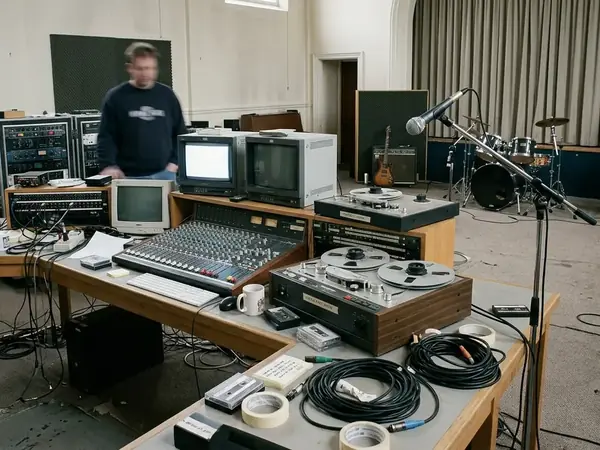
Process documentation supports a context-dependent approach here. A dry studio may need added room capture or convolution support, while a resonant chapel may call for closer main-array placement and slightly slower tempi than a fast contrapuntal movement would tolerate. These placement ranges assume a quiet, chamber-sized space; a noisy recital room or an unusually live stone interior may demand tighter pickup and less hall contribution.
Optimizing Playback for String Resonance
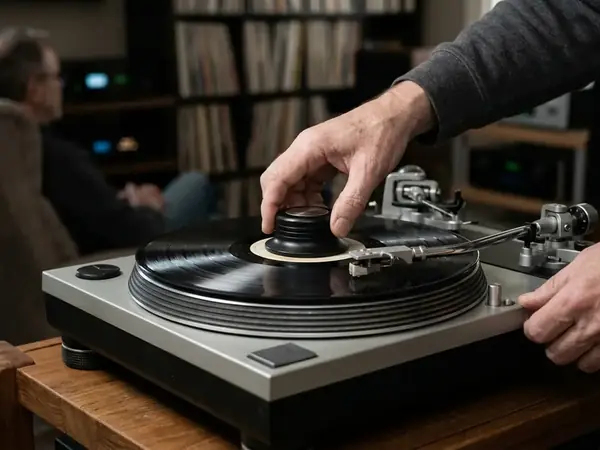
Playback is the final acoustic reconstruction step. If the loudspeakers cannot hold a stable center image, or the room masks the lower midrange, the careful microphone discipline upstream is wasted.
Speaker Geometry and Imaging
A practical starting point is an equilateral or slightly wider triangle, speakers 1.8 to 2.6 m apart and the listener 2 to 3 m from each. Adjust until the cello has body without pulling to one side and the violin image floats above and between the cabinets. Keeping baffles roughly 0.7 to 1.1 m from the front wall reduces low-mid thickening that masks cello articulation, while side-wall clearance near 0.5 to 0.9 m improves image stability in ordinary rooms.
Amplification and Low-Frequency Control
Amplifier damping factor is most audible with cello when the loudspeaker impedance curve and woofer alignment permit low-frequency overhang. Values in the broad range of 50 to 200 are usually sufficient for electrical control, though room modes generally dominate perceived decay below 120 Hz. Chasing exotic damping figures rarely solves a problem the room is actually causing.
For midrange clarity, first-reflection treatment using absorptive panels about 5 to 10 cm thick, ideally with a small air gap, reduces smearing in the 500 Hz to 3 kHz band where violin harmonics and cello overtones interact most intensely.
Summary: The violin-cello duo rewards an acoustic discipline that runs end to end: write for diverging registers, capture with coherent minimalist arrays in a room with appropriate decay, and reproduce on speakers that hold the center and let the cello breathe. No single stage guarantees the result, and the figures above describe typical chamber-sized conditions rather than every hall — but treated as a chain, they reconstruct a performance instead of merely documenting one.