The Myth of the Meritocratic Canon
The standard classical canon is not a pure meritocracy of the finest works; it is a historical artifact shaped by publishing economics, available parts, rehearsal schedules, and presenters’ appetite for risk.
Before a quartet reaches the stage, practical filters have already narrowed the field. Usable parts must exist. Musicians need enough time to prepare them within an engagement schedule. Replacement players must be able to obtain matching editions without forcing a fresh round of part preparation. For a chamber series planned six to 15 months ahead, the decisive question may concern the date of the repertoire meeting rather than the quality of the score.
Safety in Repetition
Warhorses solve institutional problems. Their parts circulate widely, ensembles know the rehearsal demands, and presenters can describe them to an audience in a few familiar words. Repetition supplies dependable programming, yet it gradually converts historical convenience into an appearance of artistic inevitability.
Consider George Onslow’s corpus of 70 quartets and quintets against the handful usually encountered in current catalogues. Then place Florence Price’s String Quartet No. 2, written in 1935, beside the recovery of a cache of her manuscripts in 2009. Each case exposes a break in repertory transmission that has little to do with the musical substance of the work.
The Missing Shelf
A work absent from concert life may have lost its route to performers long before listeners had any chance to judge it.
Scores available through the International Music Score Library Project (IMSLP) can reopen part of that route. Availability alone does not secure a performance, but it removes one quiet veto. For high-fidelity listeners, these under-programmed margins offer a genuine frontier: music heard without decades of interpretive consensus standing between the loudspeaker and the ear.
The Acoustic Cost of the Familiar
Familiarity changes the act of listening. Once an audience knows every cadence, entrance, and climactic turn, the brain begins to anticipate the performance. Missing spatial or timbral information becomes easier to overlook because memory supplies a persuasive substitute.
Reference-Recording Fatigue
Reference-recording fatigue is best treated as a listening behavior rather than a clinical condition. Its diagnostic question is simple: does the listener describe the sound being reproduced, or immediately rank the interpretation against a historic benchmark?
“Slower than the classic account” identifies comparison. “The viola shifts left during the crescendo” addresses image stability. “The room decay masks the second violin release” identifies a relationship between performance, hall, and recording chain. The latter observations demand more from the system and from the person using it.
A controlled exercise can make the difference audible. Choose three uninterrupted excerpts lasting 75 to 120 seconds: an exposed soft passage, a dense ensemble climax, and a transition containing rests. Set gain once from the loudest excerpt and leave it unchanged. After each passage, allow 45 to 60 seconds for written observations.
- For the soft passage, note bow texture, low-level room sound, and the continuity of sustained tones.
- At the climax, listen for hardened string tone, collapsed depth, or players merging into a single bright mass.
- During rests, follow releases, reverberant tails, page movement, and the acoustic distance between instruments.
Standard repertoire makes this exercise surprisingly difficult. Familiar harmonic progressions let the listener fill in blurred inner voices, while known structures soften the impact of uncertain timing or compressed dynamics. An unfamiliar score removes that assistance. Every transition must be heard as sound before it can become memory.
Engineering the Unfamiliar
An unknown string work changes the order of operations in the recording room.
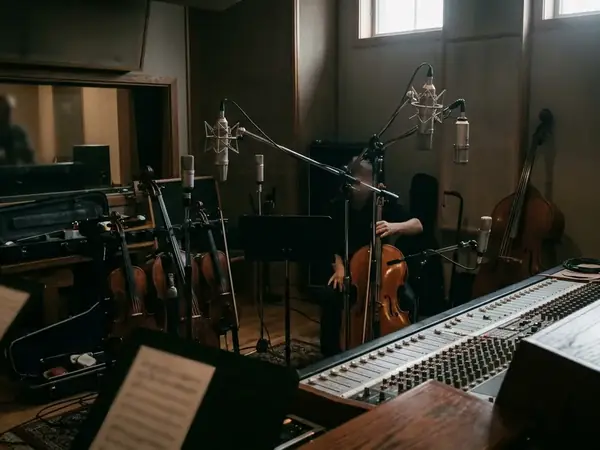
In our textual archival work documenting world-class string performances, the recurring sequence is score first, room second, microphones third. The score is marked for registral collisions, exposed entrances, unusual articulations, and passages where the inner voices carry structural weight. Without an established reference to imitate, microphone placement has to answer the composition in front of the ensemble.
A Score-Led Setup
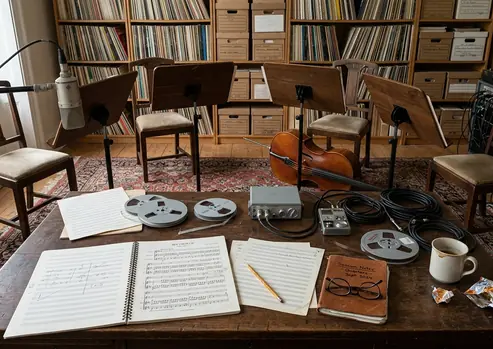
A disciplined session can reserve 30 to 45 minutes before the first complete take for four tests: soft sustained harmony, the strongest tutti, exposed inner-voice writing, and pizzicato or col legno material. Once seating, ventilation, and audience conditions have stabilized, recording 60 to 90 seconds of room tone preserves an essential editing resource.
For a quartet in a moderate recital room, a plausible starting geometry places the main pair approximately 1.8 to 2.7 metres high and 2 to 3.5 metres from the ensemble. Support microphones, when the score requires them, may begin roughly 0.7 to 1.3 metres from their instruments. Test passes should retain 12 to 18 dB of peak headroom. Change one variable at a time, then replay each adjustment for 40 to 90 seconds.
- Map the score. Mark where texture, register, and articulation challenge the room or microphone array.
- Test the acoustic extremes. Compare the quietest sustained writing with the strongest ensemble passage.
- Adjust one element. Move height, distance, angle, or support level separately so the cause remains audible.
- Inspect silence. During editing, check rests and releases before judging attacks.
A splice may preserve pitch and rhythm while shortening a reverberant tail or making chair noise jump between takes. Those faults become especially damaging in unfamiliar music because the listener lacks a remembered performance to smooth over the discontinuity.
Room Versus Score
A dry studio exposes bow articulation and edit boundaries while reducing ensemble bloom. A reverberant church enlarges harmonic color while risking obscured inner voices. Score density, articulation, seating, and intended playback level should decide the balance.
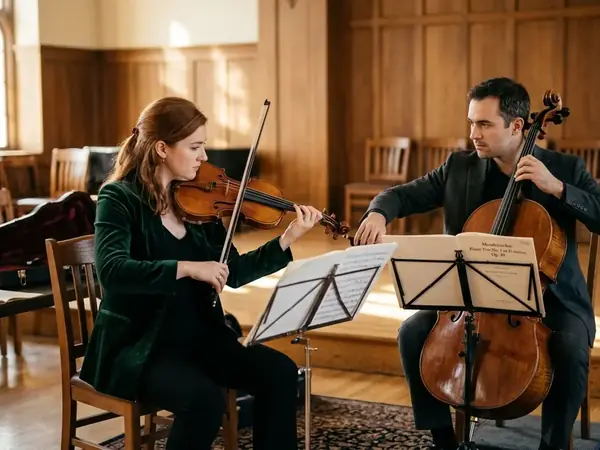
Musicians also listen differently when precedent offers little shelter. A line associated with the violin’s brilliance, such as repertoire explored by violinist Arturo Delmoni, demands a different acoustic judgment from a cello-led texture suited to the expressive weight associated with cellist Nathaniel Rosen. The useful comparison concerns register and balance, not celebrity. Unfamiliar writing keeps attention fixed on what the instruments and room are doing now.
A Strategy for Repertoire Expansion
Random novelty produces a scattered education. Musical adjacency builds a durable one.
Begin with instrumentation and language already familiar, then alter one dimension at a time: composer, region, period, or harmonic vocabulary. A listener comfortable with late Romantic string writing might move toward an early 20th-century tonalist. Someone grounded in central European quartets can follow the same ensemble into a regional chamber tradition. Transitional works between the Classical and Romantic periods provide another productive route because their formal outlines remain legible while their rhetoric starts to shift.
A Six-Week Listening Cycle
Choose two unfamiliar works per week. Give each one a 25 to 40 minute uninterrupted hearing, followed by a second session using the score or a movement map. For the third encounter, change the monitoring condition by using headphones or a different loudspeaker position.
This sequence separates three questions that catalogue browsing often muddles together: Is the composition compelling? Does the interpretation reveal its structure? Does the recording preserve convincing instrumental and spatial information?
Rarity Has Limits
Novelty alone cannot rescue weak composition or poor engineering. If an obscure quartet remains structurally inert after several attentive hearings, or microphone overload hardens every forte, scarcity supplies no reason to praise it.
How to Judge the Recording
- String timbre: Sample 30 to 60 seconds each of high violin sustains, viola middle register, and cello below the tenor range. Glassy upper harmonics that remain fixed as dynamics change can indicate microphone or mastering emphasis rather than bow color.
- Spatial imaging: Find an exposed exchange among players. Check whether their positions remain stable from pianissimo to forte and whether depth survives at the ensemble climax.
- Dynamic behavior: Lower playback until room tone is just perceptible, set level once from the loudest passage, and listen for compressed crescendos, clipped attacks, or ambience that pumps after peaks.
Archival sources require a fairer test. Recordings made from shellac discs, optical film, or aging tape cannot carry the same noise-floor and bandwidth expectations as a recent native-digital chamber recording. Continuity of pitch, recoverable instrumental color, and unobtrusive restoration become the more useful criteria.
Small labels deserve the same scrutiny as famous ones. John Marks Records, as a publishing label concerned with natural acoustics and string tone, sits within a tradition where engineering choices should remain audible as choices. A modest release with stable imaging and honest timbre may teach more than a lavish production whose processing erases the room.
The Listener’s Responsibility
Overlooked chamber music survives when curiosity becomes repeatable demand. Performances, editions, and recordings all require listeners willing to spend attention and money beyond the safest catalogue titles.
A practical four-week plan replaces one familiar listening session every three or four days with a complete unfamiliar chamber work. That creates seven to 10 encounters without turning exploration into an indiscriminate trawl. Keep brief notes on instrumental color, image stability, memorable movements, and the passages that resisted immediate understanding.
After 48 to 72 hours, replay only the two movements remembered most clearly. If the musical structure, instrumental color, or spatial image becomes more intelligible, retain the recording for a complete return within 10 to 14 days. This interval gives recognition time to form while preserving the alertness of discovery.
Curiosity Becomes Demand
Purchasing the release, attending the adventurous programme, or returning to the score gives overlooked music a path back into circulation.
The reward reaches beyond cultural recovery. Unfamiliar repertoire tests transient control, low-level resolution, tonal balance, and room portrayal because memory cannot complete the performance in advance. It also restores a useful tension to listening: the system must reveal the work while the listener learns how to hear it.
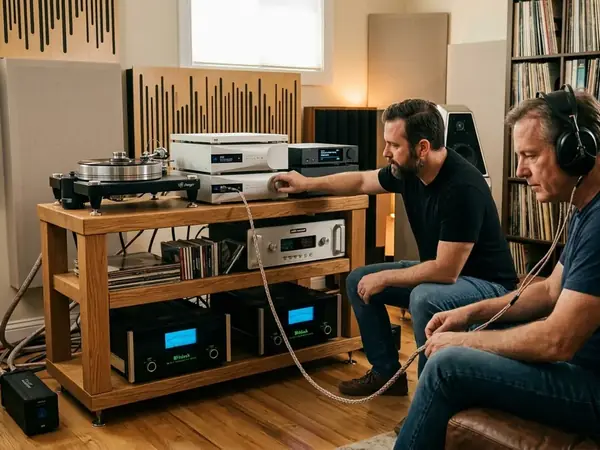
When you sit down in front of your system tonight, will you reach for the comfort of a familiar masterpiece, or will you demand that your ears—and your equipment—work to discover something entirely new?