Defining the Acoustic Character of a Classical Recording
Acoustic character begins with what reaches the microphones: the instrument’s direct wavefront, the timing and direction of the first reflections, the frequency-dependent decay that follows, and persistent effects such as reinforcement from the stage floor. Together, these components determine whether a performance sounds intimate, expansive, brilliant, warm, or blurred.
In classical recording, the room acts as a secondary instrument. Its dimensions establish reflection paths. Its materials absorb or return particular frequencies. Its geometry changes ensemble width and the apparent distance between listener and performer. A violin tone therefore carries more than the vibration of string and body—it also carries the venue’s response to that vibration.
This interaction is central to the high-fidelity approach associated with John Marks Records. A session involving violinist Arturo Delmoni or cellist Nathaniel Rosen would require engineers to preserve bow attack, body resonance, and acoustic bloom as one coherent event. Excessive isolation strips away that relationship and leaves the instrument detached from a credible physical space.
Survey Before Setup
A practical venue survey records room dimensions, surface construction, occupied seating condition, stage layout, temperature, and relative humidity. Engineers should then capture 30–60 seconds of room tone at every proposed main-array position. Ventilation, lighting systems, traffic, and structural noises often become apparent only through microphones.
Distance Changes Articulation
Moving a main pair from 2 metres to 4 metres from a quartet can alter the direct-to-reverberant balance more decisively than a small equalizer adjustment, even when the instruments and microphone model remain unchanged.
Reading Reverberation, Reflections, and Critical Distance
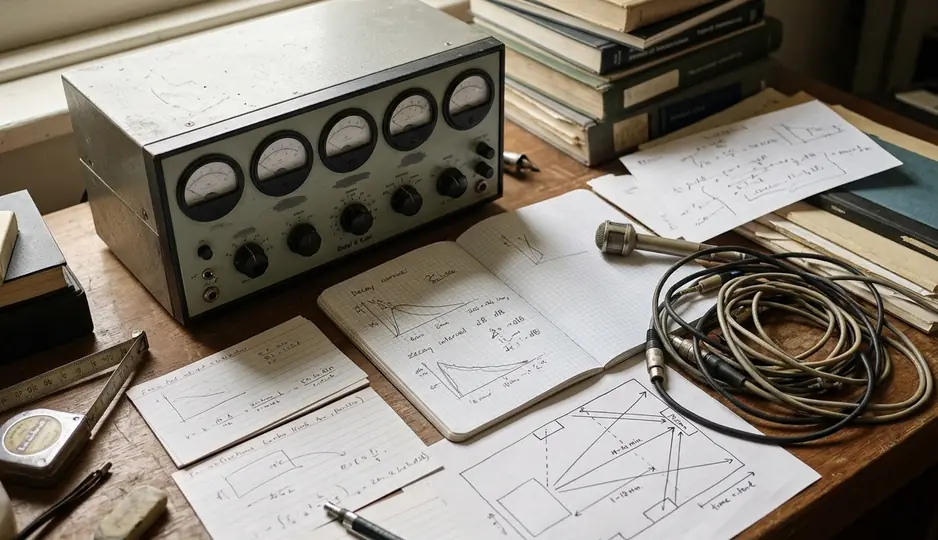
Reverberation Time (RT60) denotes the interval required for sound energy to decay by 60 decibels. In practice, the room’s noise floor may obscure a complete 60-decibel trace, so engineers commonly derive RT60 from a measured 20- or 30-decibel slope.
A single RT60 figure conceals too much. Decay should be examined in octave or one-third-octave bands because a room may hold energy around 500 hertz while losing upper harmonics much sooner. That distinction directly affects the perceived body of a cello, the sheen of violins, and the clarity of inner orchestral lines.
The First 50 Milliseconds
Reflections arriving roughly 5–50 milliseconds after the direct sound contribute localization, intimacy, and apparent source width. A reflection delayed by 10 milliseconds represents about 3.4 metres of additional acoustic path at a room temperature near 20 degrees Celsius. Denser energy arriving later forms the reverberant tail and supplies envelopment.
Microphone placement must balance both regions around the room’s critical distance. Inside that boundary, direct sound dominates. Beyond it, reverberant energy assumes greater weight. A swept sine lasting 10–20 seconds, repeated at two or three stage positions, helps expose asymmetries caused by walls, seating, and ceiling geometry.
When a Stone Nave Becomes Part of the Score
A large cathedral can make one sustained chord feel almost architectural. Sound rises into the nave, returns from stone and plaster, and gathers into a tail that appears to continue after the players have released the note. Organ pedals, choral legato, and slow polyphony can inhabit that field with unusual authority.
Large, hard-surfaced churches often produce a midfrequency decay between 3 and 6 seconds in an unamplified recording condition. Stone, plaster, and glass supply little porous absorption, so energy at 500 hertz and 1 kilohertz may remain dense even as air absorption shortens the highest-frequency tail. This range must be verified in the building’s session configuration; seating, tapestries, timber roofs, and an audience can reshape it substantially.
Keeping Rhythmic Edges Intact
Repeated semiquavers may overlap across several subsequent notes in such a long decay. Engineers should first position the ensemble away from columns or transepts that create a strongly unbalanced early reflection. For a small group, a main array can begin 2.5–4 metres above the floor and 3–6 metres from the performers.
Adjustments in 0.5-metre increments provide a controlled way to recover consonants, bow changes, and pulse. Outriggers should wait until the central image and articulation are stable; adding width to an already diffuse field can weaken musical focus.
Shoebox Halls for Scale, Salons for Bow Detail
The classic shoebox concert hall earns its reputation through lateral energy. Side-wall reflections approach the main array from useful angles, enlarging apparent source width while preserving a stable orchestral centre. Their direction and level matter as much as the headline reverberation time.
In an occupied symphonic hall, midband decay commonly sits near 1.8–2.2 seconds. Useful side-wall reflections may reach the array within 20–80 milliseconds. This combination suits full symphonic writing because it supports breadth without surrendering the separation of instrumental sections.
A furnished chamber salon operates at a more intimate scale. Its midband decay may fall near 0.8–1.3 seconds, with closer early reflections preserving rosin noise, bow onset, and the audible spacing among players. For a string quartet, that balance often feels more truthful than the distant grandeur of a large auditorium.
Auditioning the Quartet Perspective
Place the main pair 2–3.5 metres from the quartet at a height of 2–2.8 metres. Record the same 60–90-second passage at each position, keeping gain and ensemble layout fixed. A passage containing attacks, sustained chords, and quiet internal movement gives a more useful comparison than isolated tuning notes.
The preferred position should retain the friction of the bow while allowing the four instruments to merge into a plausible acoustic whole.
Timber Warmth and the Bright Return of Masonry
Wood-lined recital rooms often present strings with a settled, rounded character. A suitable room may show a midband decay of roughly 1.1–1.6 seconds, with a modestly shorter decay above 2 kilohertz when occupied seating and soft furnishings are present.
The word warm, however, requires inspection. Thin timber panels mounted over air cavities can flex and absorb selected lower frequencies. Curtains, upholstery, panel joints, and surface finishes may provide more upper-frequency control than the wood species itself. Cello and viola fundamentals extend across approximately 65–700 hertz, while bow noise and upper harmonics continue several kilohertz higher; each region meets a different combination of panel resonance and porous absorption.
Turning Away from the Apse
A small masonry chapel offers a contrasting signature: bright, reflective, and immediate. With a decay around 1.2–2.5 seconds, it can serve solo baroque violin or early music that benefits from a brilliant upper register and clearly exposed articulation.
Map the apse and side-wall returns before settling the performer’s orientation. A solo violin pair may begin 1.5–3 metres away, then rotate 10–20 degrees from a forceful apse reflection. That small angular change can retain brilliance while preventing one hard return from pulling the recorded image sideways.
How the Scoring Stage Trades Bloom for Control
A modern scoring stage feels spacious before it sounds reverberant. Its large volume gives an orchestra physical scale, while curtains, absorptive banners, movable reflective panels, and low-frequency trapping keep the decay under deliberate control.
Such a room may enclose roughly 10,000–25,000 cubic metres while maintaining a midband RT60 near 0.9–1.5 seconds, depending on the variable treatment. Engineers can therefore capture a large ensemble with greater sectional separation and add artificial reverberation later. The trade-off is a reduced contribution from naturally developing acoustic bloom.
Reset, Sweep, Listen
- Arrange the ensemble before adjusting treatment, since players, chairs, risers, and music stands alter the reflective field.
- Set the main array at an initial height of 3–4.5 metres to establish coherent ensemble scale.
- Place sectional microphones about 1–3 metres from their sources, avoiding the exaggerated perspective of close-pop positioning.
- After each major curtain or baffle change, record a 10–20-second sweep and at least 30 seconds of room tone.
The final check catches more than altered decay. A moved panel may expose ventilation noise, while retractable hardware can begin rattling at a particular orchestral frequency. Finding either problem before a full take protects both the performance and the edit.
Matching the Score, Array, and Room
Venue selection should begin with the score. Engineers classify its note density, articulation, ensemble size, dynamic range, and historical sound world, then compare those requirements with band-by-band decay and early-reflection measurements.
Dense, fast orchestral writing generally retains greater rhythmic separation around a 1.5–2-second midband RT60 than in a 4-second nave. Sustained organ or choral music can use the longer tail as part of the composition. The room choice therefore precedes microphone choice.
A Repeatable Placement Sequence
- Establish the main array and record a fixed 60–90-second musical passage.
- Move the array in 0.5-metre steps until attacks remain intelligible while the desired acoustic bloom survives.
- Add outriggers only after the centre image, depth, and direct-to-reverberant balance are stable.
- Introduce spot microphones for a defined musical reason, then align their attacks so they reinforce rather than smear the main pickup.
A conventional Decca Tree provides a useful orchestral starting geometry: left and right microphones about 2 metres apart, with the centre microphone approximately 1.5 metres forward. Final spacing and height follow the ensemble width and lateral reflections. ORTF offers a more compact footprint for quartets and smaller rooms, using two cardioid microphones 17 centimetres apart at an included angle of 110 degrees.
Measure the Air
Temperature and humidity belong in the placement log because air absorption changes along the path between performers and microphones. When relative humidity shifts materially, the listening pass and impulse-response measurement should be repeated before equipment receives the blame.
In a large hall, the air itself becomes an equalizer: a change from 60 to 40 percent relative humidity across a 20–40-metre orchestral path is enough to trigger a fresh measurement of the violin section’s upper-frequency energy.