Acoustic Vulnerability in Three-Part Scoring
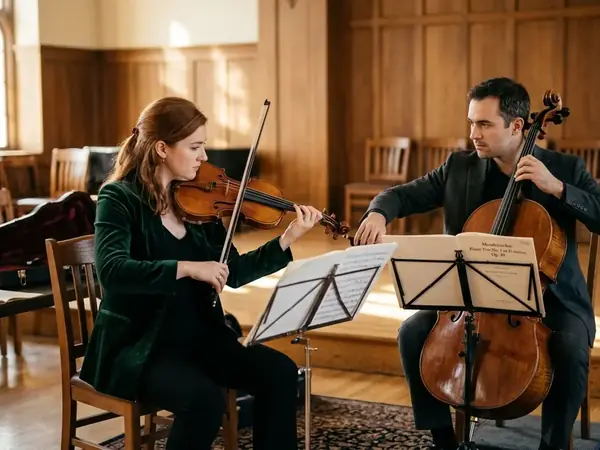
In a string trio, each player carries unusual harmonic and acoustic responsibility. The visual geometry of three players immediately signals an acoustic vulnerability. Remove the second violin, and the ensemble loses its harmonic safety net. There is no middle treble line available to reinforce a chord, conceal a cautious entrance, or absorb a tuning discrepancy.
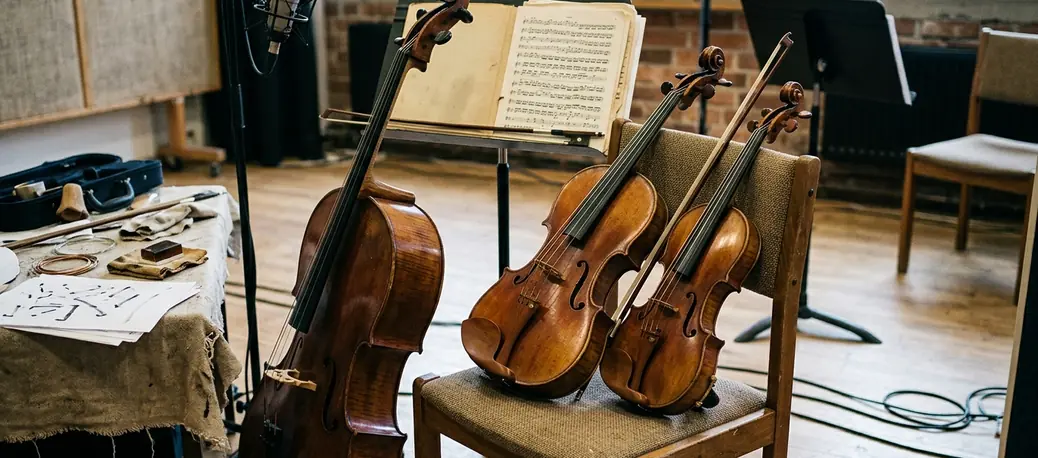
Every intonation flaw and bowing hesitation is instantly exposed to the listener. The physical resonance of the wooden bodies must fill the acoustic space entirely on their own merits. The listening test therefore begins with exposed attacks and sustained intervals. Clean attacks establish ensemble unanimity, setting the foundation for the entire performance.
A high-resolution audio system will either reveal the architectural brilliance of three independent voices or ruthlessly highlight a muddy recording. At standard pitch (A4 = 440 Hz), the viola's open C3 sits at approximately 131 Hz. The cello's open C2 drops to roughly 65 Hz. A playback system that reproduces mainly their upper harmonics leaves the two instruments sounding thinner and spatially less stable than they were in the recording session. Session documentation records Arturo Delmoni's violin attacks alongside Nathaniel Rosen's cello responses, making the capture of fundamental frequencies especially important for natural reproduction. The interplay between these frequencies dictates the perceived warmth and physical presence of the ensemble in your listening room.
Diagnostic Tip: Room Interference vs. Ensemble Intonation
Use a 20-40 second passage containing sustained double stops or parallel motion. Move your listening position 20-30 cm forward or backward. A large change in image focus points toward room interference rather than an ensemble suddenly losing intonation.
Redistributing Labor Across the Strings
The historical development of this repertoire organizes itself around the redistribution of labor. The trio format forces the viola and cello to constantly alternate between rhythmic foundation and melodic lead. Boccherini established the early parameters of the form. His Op. 14 set, catalogued as G. 95-G. 100 and dating from 1772, comprises six trios for violin, viola, and cello. This balanced three-part scoring remains central to the later repertory.
Three strings can sustain extended discourse through rapid exchanges of melody, accompaniment, and bass function. The listener experiences a constant shifting of weight and responsibility among the players.
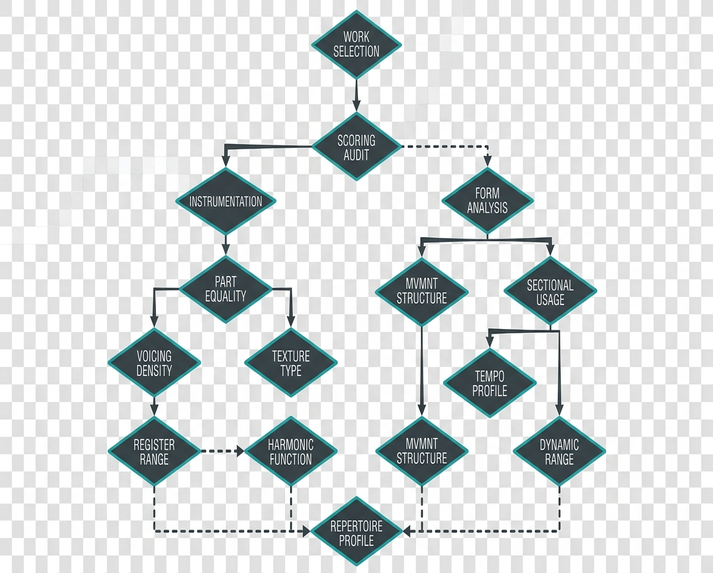
Mozart makes this exchange unavoidable. He completed the E-flat Divertimento K. 563 in 1788. Its six movements typically occupy 40-50 minutes in performance. The structure includes two minuets plus an Andante theme-and-variations movement, creating a massive structural obligation. The K. 563 six-movement viola-and-cello handoff map gives the lower strings repeated opportunities to initiate material. It stands as a masterclass in contrapuntal equality where no single instrument is allowed to hide. The sheer scale of the work demands relentless physical and mental stamina from the performers. Every phrase requires active participation, ensuring that the musical narrative remains taut and engaging from the first note to the last.
Twentieth-Century Harmonic Expansion
Composers in the twentieth century used the inherent transparency of the trio to push harmonic boundaries. The instrumentation accommodates extreme stylistic divergence. Dohnányi builds continuity from recognizable dance, variation, and rondo procedures. His Serenade in C major, Op. 10, composed in 1902, features five movements: March, Romanza, Scherzo, Theme and Variations, and Rondo. This sequence supplies formal reference points even when the viola or cello temporarily carries the melodic foreground. The result is a lush but structurally rigorous approach to the three-voice texture. The listener is guided through complex harmonic shifts by the familiar signposts of traditional forms.
Schoenberg turns abrupt changes of register, articulation, and tempo into the subject of the piece. His String Trio, Op. 45, dates from 1946. It unfolds as one continuous work articulated into three parts and two intervening episodes, commonly lasting 18-22 minutes. The intense, fragmented psychological writing requires absolute precision from the players—a demand that exposes any weakness in the ensemble. The music darts between extremes of volume and texture, challenging both the performers and the playback equipment to keep pace.
Françaix relies on short, sharply bounded gestures and rhythmic exactness. His 1933 String Trio uses four concise movements and generally runs roughly 12-16 minutes. The neoclassical precision contrasts sharply with Schoenberg's density. Archival analysis of John Marks Records publishing label catalogs tracks these stylistic shifts across their historical release schedule, showing that instrumentation alone obscures the profound differences in density and continuity. These modern works demand a capable playback chain to untangle their complex textures and present the composer's vision with clarity.
System Diagnostics for Chamber Repertoire
System calibration proceeds in three passes so that tonal, temporal, and spatial faults remain distinct.
- Phrase Handoffs: Follow one instrument through two or three phrase handoffs. Verify that its identity survives changes of register.
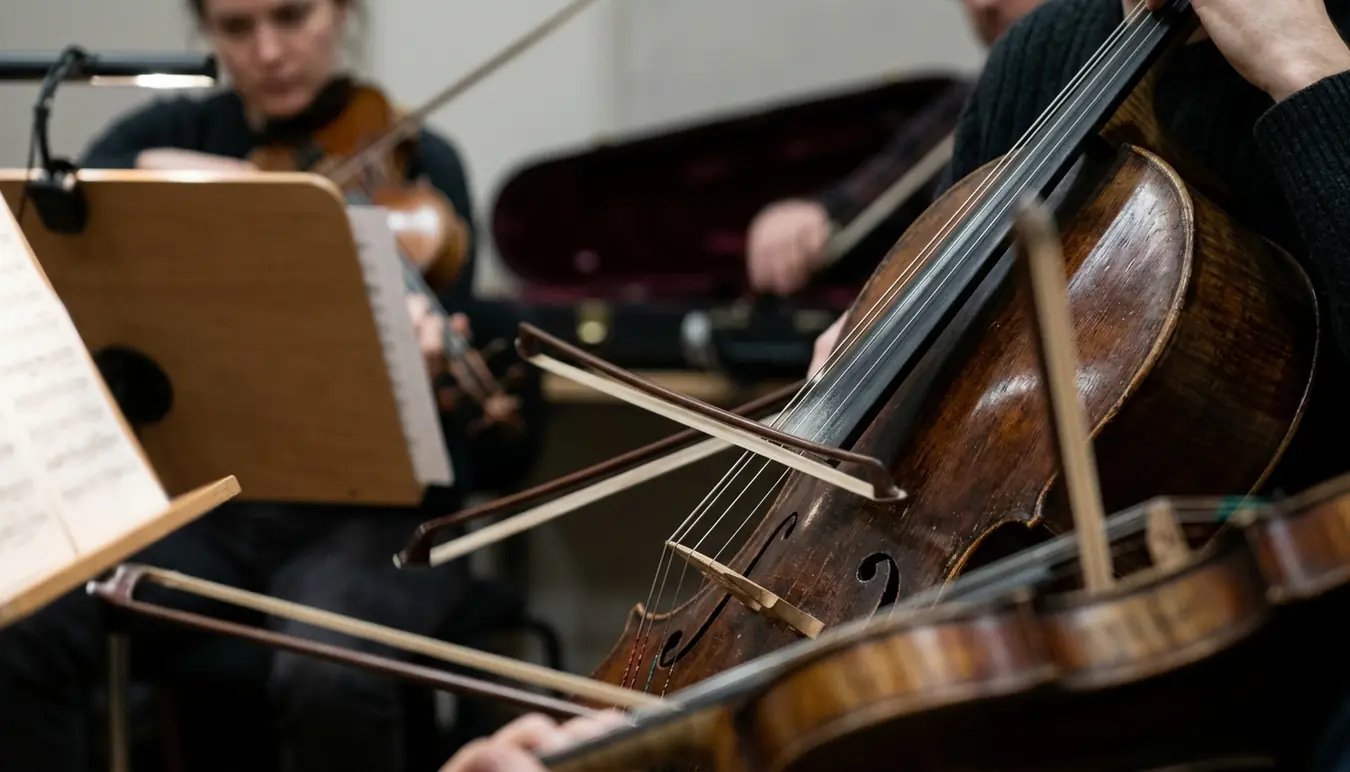
- Transient Response: Listen to the instant of bow contact. The initial scrape should be brief and attached to the ensuing note. A detached, bright click indicates a transient response issue.
- Spatial Stability: Compare the violin and cello for spatial stability. Repeat a 30-60 second excerpt at matched volume, listening first for bow attacks and then for image position.
The violin and cello should retain distinct lateral or depth cues through crescendos rather than collapsing into a single central band. The physical location of each instrument must remain rock-solid within the soundstage.
Accurate reproduction of the viola's lower register is critical to maintaining the illusion of a full ensemble. For the low-register check, use a passage where the viola occupies approximately C3-G3, 131-196 Hz, while the cello remains below it. Excess energy in the 120-200 Hz region produces warmth without separation. A deficit leaves the viola represented mostly by harmonics. Crossing the roughly 131 Hz viola-C threshold between trio body and room blur requires careful speaker placement. This left-to-right placement test yields meaningful results, assuming speaker playback that preserves lateral microphone information. Fine-tuning the system to handle these frequencies preserves the delicate balance of the trio.
When you cue up K. 563 on your system, are you hearing three distinct, uncompromising voices engaged in a unified argument, or just the blurred noise of a compromised room?