Why Do High-Resolution Listeners Gravitate Toward Historical String Setups?
Sit in front of a well-calibrated playback system and cue up a solo violin recorded in a stone chapel. Before the melody even settles, your ears register the physical contact: horsehair catching the surface of a spun sheep-gut string, a brief rasp of rosin, and an immediate bloom of woody overtones. Why does a modern, ultra-revealing audio chain make historical stringing so compelling?
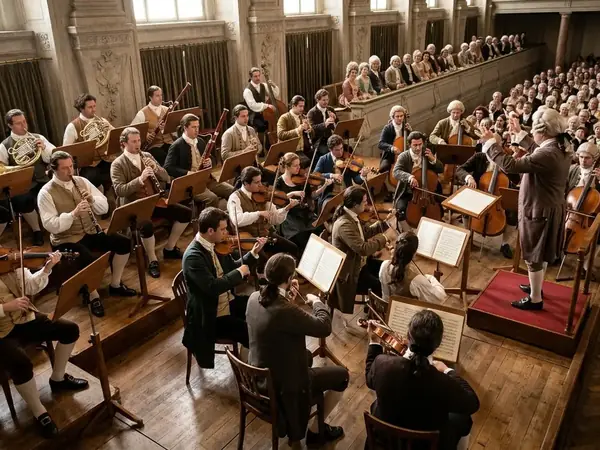
Over the later twentieth century and early twenty-first century, historically informed performance moved out of specialist early-music festivals and into established symphony halls and mainstream classical catalogs. What began as an academic recovery of period style became an unexpected gift for audiophile recording engineers. For a publishing label like John Marks Records, capturing soloists such as violinist Arturo Delmoni or cellist Nathaniel Rosen requires matching the recording philosophy to the exact physical voice of the instrument in the room.
To understand why these recordings sound so immediate, we have to separate the variables on the stage. String construction, reference pitch, bow geometry, and microphone perspective each leave a distinct fingerprint on the final master.
Historically minded players frequently adopt reference pitches such as A=415 Hz, which sits approximately one equal-tempered semitone below the modern A=440 Hz standard, or A=430 Hz, a smaller downward shift often chosen for Classical-era repertoire. Neither pitch was a universal eighteenth-century law, as historical tuning varied wildly by town and church organ, but today they serve as practical anchors for period setups. Similarly, stringing is rarely a binary choice between antique and modern. Performers choose among plain unwrapped gut, metal-wound gut, synthetic-core strings, and solid or braided steel. Even a standard modern violin setup typically pairs a steel E string with synthetic-core lower strings rather than using an all-steel configuration.
These mechanical choices reflect fundamentally different musical goals. Late-Romantic concerto projection across a massive twentieth-century concert hall demands rapid focus and sheer acoustic power to clear a hundred-piece orchestra. Intimate Baroque or Classical chamber articulation prioritizes rhetorical inflection, quick decay, and transparency. When a modern microphone is placed close to a violin strung for maximum orchestral projection, the high-energy upper partials that help a soloist reach the back balcony can easily overload a living-room listening space.
The Acoustic Physics of Sheep Gut, Reference Pitch, and Bow Design
Tracing the sound of a period instrument back to first principles starts with the vibrating-string equation. For any string whose vibrating length (L) and linear mass density (μ, or mass per unit length) remain constant, tension (T) follows the relationship T = 4L²f²μ, where f is frequency.
Step through the math of a simple pitch change. If a violinist takes a given string and tunes it down from A=440 Hz to A=415 Hz without changing anything else, the tension ratio drops to approximately 0.890 of its original pull. Retuning that same string to A=430 Hz yields a tension ratio of approximately 0.955. However, the A=415 bridge-load chain breaks at an undocumented gauge change: the 0.890 tension ratio describes retuning the same string, not every historically strung violin. In practice, a player dropping pitch to A=415 Hz often selects a thicker gut gauge to restore bow resistance, which increases linear mass (μ) and brings the total tension back up.
Pitch Versus Gauge Reality
Lowering reference pitch only reduces total downward force on the violin top if string gauges and neck angles remain constant. Always check whether a performer compensated for A=415 Hz with heavier gut diameters before attributing a darker tone purely to looser tension.
Once tension is established along the speaking length, the bridge translates that horizontal pull into downward force on the instrument's spruce top plate. The exact load depends on both string tension and the break angles formed over the bridge toward the tailpiece and fingerboard. Beneath the treble foot of the bridge, the wedged spruce soundpost couples the top and back plates locally, converting string energy into asymmetric body modes. When downward force is genuinely reduced, the top plate experiences less static compression, altering how freely it initiates complex overtones.
Material physics drives the next layer of tonal difference. Plain sheep gut has a much lower physical density than steel and behaves as a viscoelastic material. That internal damping absorbs high-frequency longitudinal waves before they can reflect back and forth along the string, softening the metallic zipper effect during bow changes. Because plain gut requires an impractically thick diameter to reach low bass pitches—which makes response sluggish under the bow, makers introduced metal-wound gut for the G string (and C and G on the cello). Adding a fine silver or copper winding increases mass per unit length without ballooning the string's width, meaning plain gut and wound gut require entirely separate mechanical descriptions.
For readers interested in the underlying laboratory measurements of slip-stick motion and Helmholtz corners, a detailed acoustic analysis of bowed string mechanics illustrates how string damping shapes the sawtooth waveform at the bridge.
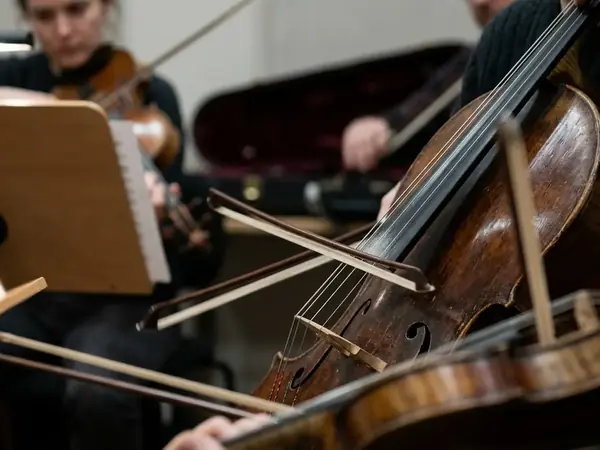
The bow completes this mechanical circuit, though historical bows resist simple generalizations. Convex Baroque bows, transitional eighteenth-century bows, and standard modern François Tourte-pattern bows belong to distinct structural families. A Tourte-pattern bow is a foundational late-eighteenth-century design designed for sustained cantabile lines and even weight distribution from frog to tip; its presence is not evidence of a lightweight early-music setup, nor do physically lighter bows automatically operate at lower hair tension. What we hear as a classic Baroque swell and release over a single bow stroke comes from how the musician loads and releases index-finger pressure and bow speed into a compliant gut string, rather than a compulsory decay built into the wood of the stick.
How High-Resolution Playback Systems Expose Upper-Midrange Glare
When an audiophile complains of string glare on a digital release, the culprit is rarely the string material alone. Glare is an interaction between the acoustic source, the microphone perspective, and the domestic playback chain.
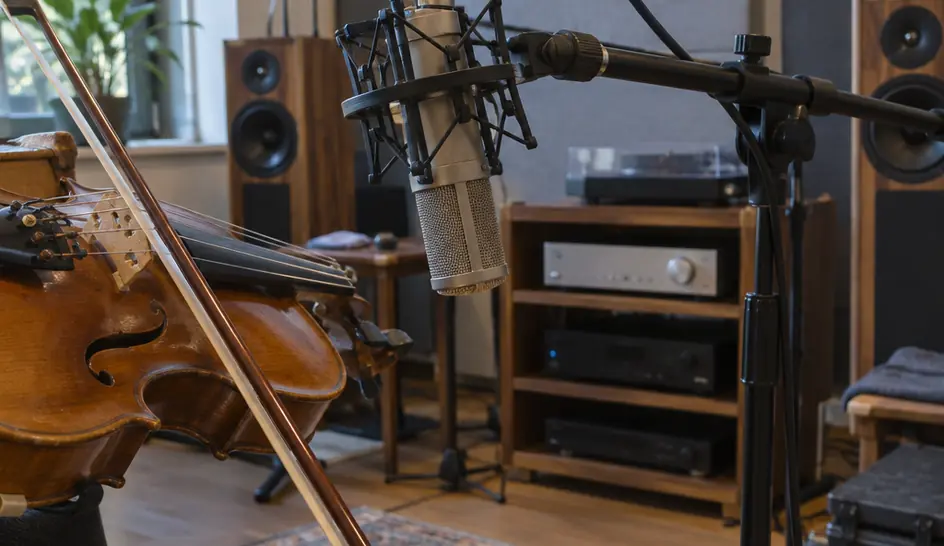
Modern high-resolution transducers—whether electrostatic panels, ribbon tweeters, or stiff beryllium domes, excel at reproducing fast transient edges. Yet transducer material labels do not guarantee tonal neutrality. How that transient energy reaches your ears depends on the speaker's measured off-axis response, your listening triangle geometry, and early reflections off bare walls or hardwood floors. When a close spot microphone captures a steel E string from two feet away, the direct radiation of bow-hair friction and high-order harmonics in the 3 kHz to 6 kHz region can dominate the recording. Played back at realistic concert volumes in a small room, that concentrated 3–6 kHz energy easily triggers listener fatigue.
Gut strings offer a different acoustic profile in that sensitive 3–6 kHz band, presenting textural rasp and rapid high-partial damping rather than sustained metallic ring. Where session logs from classical location recordings track microphone placement, the balance between direct bow articulation and hall bloom proves decisive.
Capturing this balance requires a disciplined session protocol:
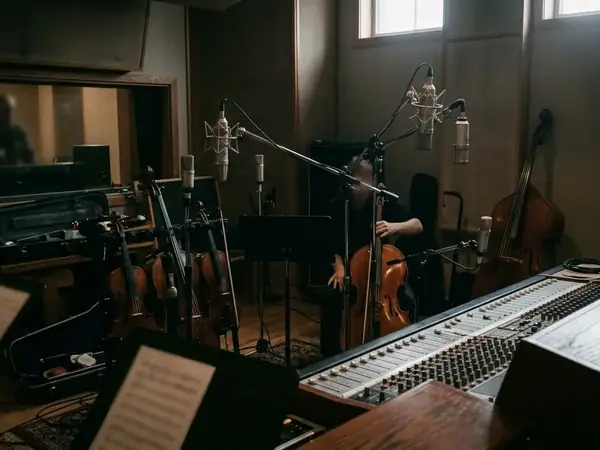
- Establish the starting geometry: Begin with a main stereo microphone pair positioned 1.5 to 3 meters from a solo violin. Have the soloist repeat a single demanding phrase while moving the stands in 20 to 30 cm increments until the direct bite of the bow locks into focus with the room's early reflections.
- Capture a baseline noise profile: Record a 30 to 60-second room-tone sample before the first take. Distant air-conditioning rumble, exterior traffic, or transformer hum that seems unnoticeable during loud passages will surface and ruin the quiet decay of a gut-string chord.
- Monitor environmental stability: Log room temperature and relative humidity at the start of the session and immediately after every break, checking tuning before each take. Because sheep gut is hygroscopic and responds rapidly to moisture shifts in the air, documenting humidity prevents engineers from blaming pitch drift on the performer's intonation.
Even with pristine engineering, a distant stereo pair in a reverberant church remains effective only when ambient noise stays well below the quietest musical decays and humidity keeps the gut stable across editing takes; otherwise, the added room wash obscures the very articulation the setup was meant to capture.
Auditioning the Tonal Palette on Your Own Playback System
Over the past few decades, many classical collectors have shifted their preference away from the dense, homogenized orchestral wall of sound toward recordings that preserve scale, breathing room, and rhetorical nuance. When you listen to a solo work performed by an artist like Arturo Delmoni or a cello suite shaped by Nathaniel Rosen, the pleasure lies in hearing the physical mechanics of music-making unvarnished by heavy mixing-console intervention.
Instead of relying on vague impressions of warmth, you can turn this aesthetic comparison into a repeatable home listening procedure.
Step 1: Select and Level-Match Your Excerpts
Choose a 20 to 30-second passage from a solo work you know intimately, such as a movement from a Bach Partita that features a rolled three- or four-note chord followed by a clear silence. Locate two recordings with documented setups—one utilizing period gut and another using a modern steel-and-synthetic configuration. Make sure you compare the exact same musical measures rather than jumping between different sections of the movement.
Before judging tonal brightness, calibrate your playback volume. Using a smartphone SPL meter at the listening chair or an audio editor's loudness meter, match the average playback level of both excerpts to within approximately 0.3 dB. Without level matching, a slightly louder transfer will almost always register as more forward or glaring, skewing your evaluation of the strings.
Step 2: Run a Structured A/B/A Protocol
Cue both tracks so you can switch between them with a 2 to 3-second gap. Listen in A/B order, then immediately reverse to B/A order to prevent ear bias toward whichever version plays first. Rather than assigning an overall preference score, write down specific observations across three acoustic checkpoints:
- Initial bow grip: Focus on the first fifty milliseconds of the stroke. Does the bow catch the string with a dry, papery friction, or does the note speak with a glassy, immediate whistle?
- Chordal blend and double-stop beating: Listen to the internal stillness of double-stops. An ideal pure fifth vibrates at an exact 3:2 frequency ratio. When a soloist tunes a fifth purely on gut or modern strings, the partials lock together with minimal amplitude beating. Notice that reduced beating reflects the precise pitch relationship chosen by the player and how the overtones align—it does not, by itself, prove which string material is on the instrument.
- The transition from instrument to venue: Follow the end of a rolled chord as the bow leaves the string. A Partita chord's fading church reverberation marks the boundary between string response and recorded venue; a longer tail is not, by itself, evidence of richer gut-string resonance.
Room Reflections Versus String Bite
If both recordings sound aggressively pinched in the upper midrange during your A/B test, pause the software comparison and measure your loudspeaker toe-in angle before blaming the recording engineer's microphone choice.
Step 3: Isolate Loudspeaker Directivity
Once you have logged your notes from a fixed listening seat, test how your room interacts with the upper harmonics. Keep the volume locked at your 0.3 dB matched reference and rotate your loudspeakers' toe-in angle in 5-degree steps—first pointing them directly at your ears, then firing slightly wider past your shoulders. Pay close attention to whether the perceived bite at the start of the bow stroke softens as you move off the tweeter's primary axis, or if the textural difference between the two string setups remains consistent across every angle.
To put this framework into practice tonight, cue up your level-matched 20-second Bach Partita chord excerpts, close your eyes during the final release of each chord, and write down the exact timestamp where the woody decay of the violin body stops and the stone reflection of the recording venue takes over.