In this Article
- The Challenge of Capturing Classical Strings
- Acoustic Radiation Patterns of String Instruments
- The Case for Minimalist Microphone Arrays
- Core Stereo Topologies: Blumlein, ORTF, and Spaced Omni
- Transducer Selection and Signal Chain Protocol
- Step-by-Step Microphone Placement Methodology
- Managing Room Acoustics and Environmental Variables
- Scope and Limitations in Post-Production
The Challenge of Capturing Classical Strings
Treat the ensemble as one acoustic event
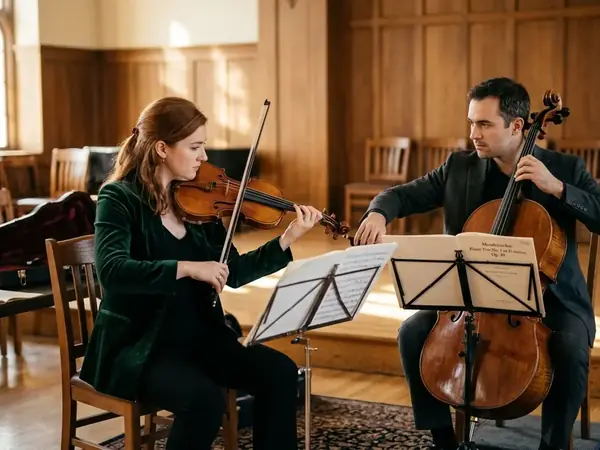
The first decision is not where to put the nearest microphone. It is whether the recording should present Arturo Delmoni, Nathaniel Rosen, or a full string section as separate objects, or as a single musical event unfolding in a room.
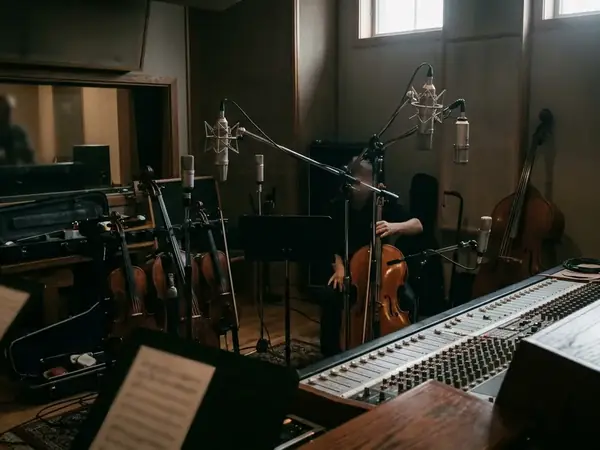
Minimalist string recording begins with the second view. Bowed instruments generate tone through friction, resonance, and radiation in several directions at once. The bow attack can be startlingly quick; audible transient energy may reveal placement errors within the first 10 to 30 milliseconds of a note, especially on accented violin and viola entrances. A microphone that sits too close often magnifies the mechanics of the bow before the instrument body has spoken.
Why more microphones can make less truth
Multi-miking gives the mixer apparent control, but that control has a cost. When two microphones capture the same instrument with path-length differences in the roughly 5 to 40 millisecond range, comb filtering can become plainly audible. The result is familiar: a hollowed tone, a wandering image, or a stereo picture that seems wide without becoming believable.
That problem becomes more severe with strings because the ear reads intonation, bow pressure, and ensemble blend as one integrated cue. If the first violin spot microphone arrives out of relationship with the main pair, the section can sound closer without sounding clearer.
Summary: The minimalist method aims to preserve the natural acoustic envelope: direct articulation, body resonance, early room response, and decay in a coherent spatial order.
Acoustic Radiation Patterns of String Instruments
Sound does not leave the instrument in a straight line
A violin is not a small loudspeaker aimed at the bridge. Nor is a cello a single forward-facing source. Each string instrument radiates in a 360-degree field, and the balance changes with register, bow position, dynamic level, and the room surfaces nearby.
The top plate supplies much of the articulate midrange and bow definition. The f-holes and back plate contribute lower resonance and body weight, though their influence changes as the player turns slightly or leans into a phrase. This is why an array aimed blindly at the bridge often records a technically detailed but emotionally thin instrument.
Starting distances for solo instruments
For solo violin or viola, based on creative process, a serious first test position commonly sits 1.5 to 2.5 meters from the instrument and 1.8 to 2.4 meters above the floor. After listening, the engineer adjusts by 10 to 20 centimeters, not by dragging the stand across the room.
Cello placement asks for particular restraint. The array usually stays high enough to avoid overemphasizing the f-hole region directly in front of the body; a practical starting height is 1.8 to 2.7 meters, depending on chair height and floor reflection strength.
Note: A placement that flatters one register may distort another. The useful position is the one that lets bow definition, body tone, and room response arrive in proportion.
The Case for Minimalist Microphone Arrays
One dominant geometry, one stable image
The final trade-off
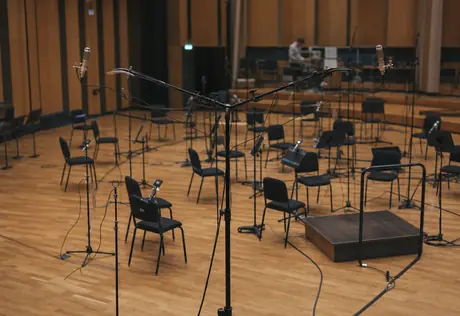
The theoretical foundation is simple and demanding: use two to three microphones to capture the whole performance, and let one primary stereo pair define the image. The mathematics favor restraint. Fewer capsules mean fewer arrival-time conflicts, fewer phase rotations, and fewer chances for the hall to be reassembled incorrectly after the fact.
When a single stereo pair governs left-right information, the cues remain tied to one geometry. The listener hears width because the ensemble occupies space, not because spot microphones have been panned into a shape. That distinction matters in chamber music, where the relationship among players carries as much meaning as the sound of each instrument alone.
The center support question
A third microphone can help, but it must not become the performance. When a center support microphone is used, its level usually enters several decibels below the main pair and rises only until the center image stops wandering. If the center mic becomes the apparent source of the ensemble, the minimalist premise has already been weakened.
Process documentation supports a practical rule: move the primary stereo pair as a unit in increments of 5 to 15 centimeters before changing microphone type or applying equalization. The array position is the first equalizer.
Core Stereo Topologies: Blumlein, ORTF, and Spaced Omni
Blumlein Pair
Blumlein looks elegant because it is unforgiving. The protocol uses two coincident figure-8 microphones crossed at 90 degrees, with both capsules occupying the same vertical plane to avoid time-offset artifacts. In a balanced hall, the front and rear lobes capture direct sound and room return with rare continuity.
The emotional effect can be vivid. A quartet does not merely sit between the loudspeakers; it breathes inside the recorded room. Blumlein, though, rewards good spaces and exposes poor ones.
ORTF
ORTF uses two cardioid microphones spaced 17 cm apart at a 110-degree included angle. The geometry mimics aspects of human binaural hearing without pretending to be a dummy head. It gives sharper localization than many omni arrangements and often suits string quartets, piano trios with strings, and small chamber forces.
A technically correct ORTF setup can still fail in a narrow rehearsal room where side-wall reflections arrive early and make first violins smear across the stereo field. In that case, the topology is not wrong; the room is arguing with it.
Spaced Omni
Spaced omni, or A/B, uses omnidirectional microphones to capture extended low-frequency response and spaciousness. For string chamber groups, arrays often begin around 40 to 70 cm apart, with wider spacing considered for larger ensembles. Any support microphone must be checked against the 3:1 distance guideline to reduce phase trouble.
A spaced omni pair that flatters a cello section in a warm chapel may overinflate double basses in a low-ceiling studio, even when the microphone spacing is unchanged. The array hears the room as much as the players.
Quick Tip: Choose Blumlein when the room deserves to be heard, ORTF when localization needs discipline, and spaced omni when low-frequency bloom and breadth matter more than pinpoint edges.
Transducer Selection and Signal Chain Protocol
Listen off-axis first
Microphone selection starts away from the centerline. Minimalist recording captures both direct sound and reflected sound, so the off-axis response shapes the hall tone. A bright microphone that seems detailed on-axis may turn steely when early reflections strike the capsule at an angle.
Small-diaphragm condensers suit fast articulation and precise imaging. Ribbon microphones suit upper strings that need a smoother top octave, provided the placement is not too distant and the room is not noisy. Ribbon microphones can tame aggressive violin sheen, but in a distant placement they may understate bow articulation and make inner viola lines recede.
Preamplifiers, cables, and restraint
The preamplifier in a minimalist chain has nowhere to hide. It needs high headroom, a low noise floor, and linear frequency response because every adjustment affects the whole ensemble. The engineer cannot brighten the second violin spot or compress the cello separately if those microphones do not exist.
Cable practice should be equally conservative. A practical minimalist setup keeps microphone cable runs short enough to avoid unnecessary handling and routing losses, commonly 5 to 15 meters from stand to preamplifier in a concert-hall or chapel setup. Clean gain, quiet routing, and solid connectors preserve the micro-dynamics that make string playing feel alive.
Step-by-Step Microphone Placement Methodology
1. Find the critical distance
The placement process begins by ear. An assistant or player performs representative passages while the engineer walks from close perspective into the hall, listening for the point where direct articulation and reverberant field reach equilibrium. That is the critical distance.
This point is not guaranteed to sit at the visual center of the room. It may be just forward of the ensemble in a dry hall, or farther back in a chapel with generous decay. The method is less reliable in cramped rooms with fast flutter, where the first reflections can outweigh the natural body of the instrument.
2. Set height before changing equipment
For quartet or small string ensemble recording, a useful first array height is 2.4 to 3.6 meters, roughly 8 to 12 feet. Lowering the array increases intimacy and bow contact. Raising it can reduce bow edge and let body resonance integrate before reaching the microphones.
Height matters because bowed strings radiate unevenly. Too low, and the array may stare into the aggressive plane of rosin, bridge, and f-hole energy. Too high, and the sound can lose grip.
3. Move in centimeters
- Place the primary array at the chosen topology and approximate critical distance.
- Record a 30 to 90 second excerpt containing attacks, sustained chords, and at least one low-register passage.
- Move the array 5 to 10 centimeters forward, backward, or vertically.
- Repeat the same excerpt without changing the players' formation.
- Check mono compatibility and phase behavior before judging tone color.
Workshop experience shows that the best pass often sounds less impressive in isolation and more convincing over an entire movement. Spectacle fades; proportion lasts.
Managing Room Acoustics and Environmental Variables
The room becomes part of the instrument
Minimalist miking has a strict limitation: it cannot rescue a bad acoustic by isolating every player. A room with short, hard, fluttering reflections between parallel walls may make a minimalist array sound smaller and harsher than a carefully controlled close-mic approach.
Room treatment should therefore proceed lightly. Clap, speak, and listen from the intended array position. Identify early reflections that repeat as metallic chatter or hard slap. Then use strategic diffusion to break up those reflections without deadening the space.
Temperature, humidity, and patience
String instruments react to the air before the microphones do. A stable session environment is typically maintained near 20 to 23 degrees Celsius, with relative humidity held in the 40 to 55 range. Players should receive 20 to 40 minutes in the recording space before final balance tests, especially when instruments arrive from a colder or drier exterior environment.
This waiting time is not ceremonial. It lets tuning settle, bows acclimate, and the ensemble hear the room. John Marks Records sessions that involve exposed string textures depend on that quiet preparation as much as on the microphone choice.
Important context: Heavy absorption can solve one reflection and remove the acoustic life that minimalist recording needs. Diffuse first, absorb only where the reflection has a clear fault.
Scope and Limitations in Post-Production
Do not undo the array
Post-production must respect the fact that the stereo pair has already encoded image, depth, and phase. Equalization can correct a narrow tonal issue, but broad tonal surgery often shifts the apparent room. Compression, if used at all, should be extremely restrained; heavy gain reduction can pull hall decay forward and make the stereo pair sound like a processed close-mic capture.
The same restraint applies to editing. Minimalist string recordings work best from complete musical takes, with patches selected for continuity of tone, energy, and decay. Edits are most convincing when the replacement phrase includes matching room decay before and after the cut, commonly requiring several seconds of usable ambience on both sides.
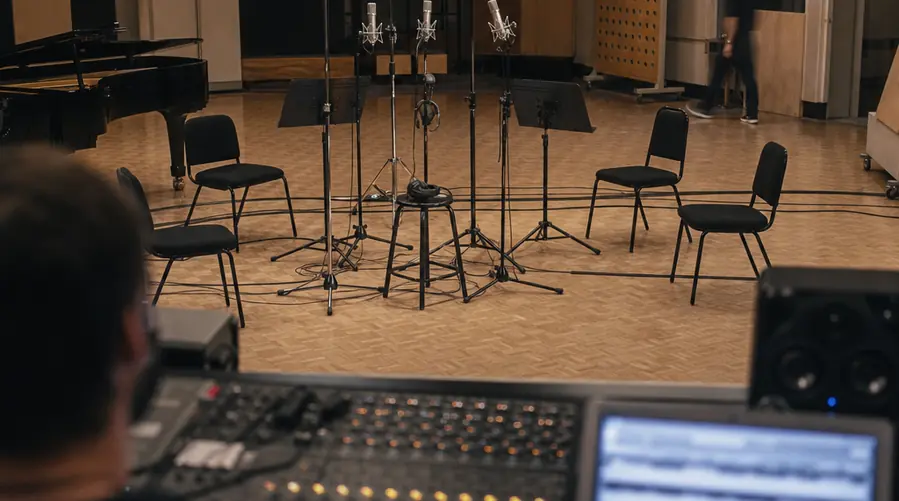
The engineer sacrifices artificial control for spatial truth. There is less opportunity to rebuild balance later, but much more opportunity to capture the performance as the musicians shaped it in real air.
That trade-off suits classical strings because the ensemble already contains its own mix. The first violin projects, the viola binds inner harmony, the cello carries resonance, and the basses ground the floor. A minimalist array does not manufacture those relationships; it preserves them when placement, room, and performance align.
References
For broader technical context on stereo methods, consult the Audio Engineering Society (AES) guidelines on stereo microphone techniques.
Summary: Minimalist miking is not a shortcut. It is a disciplined system: understand radiation, choose one coherent stereo geometry, place in small increments, manage the room conservatively, and leave post-production with as little to repair as possible.