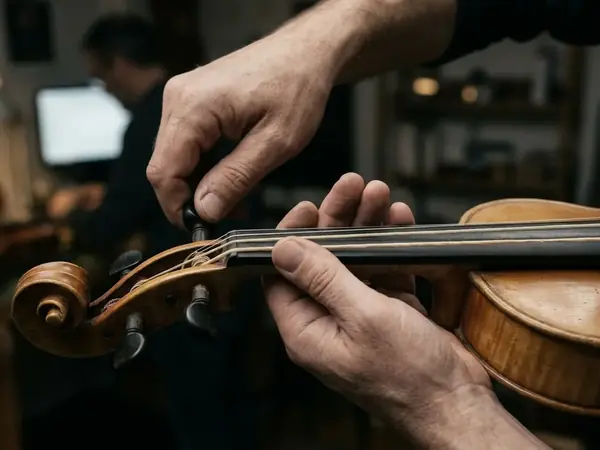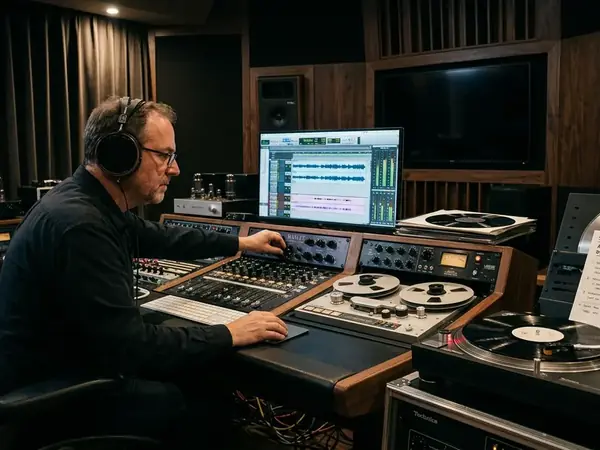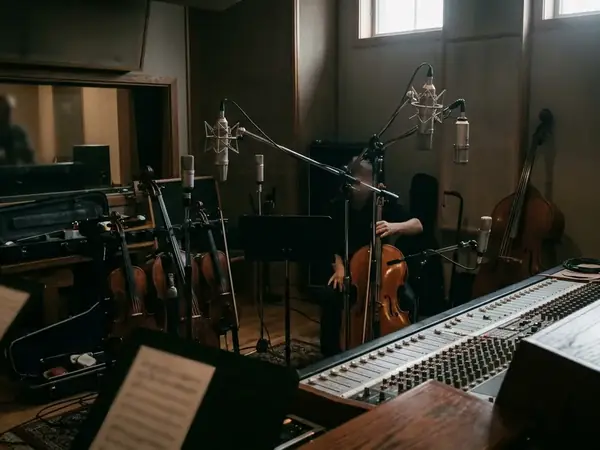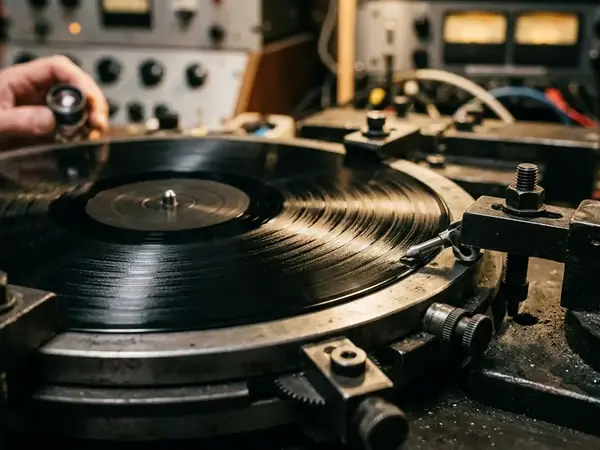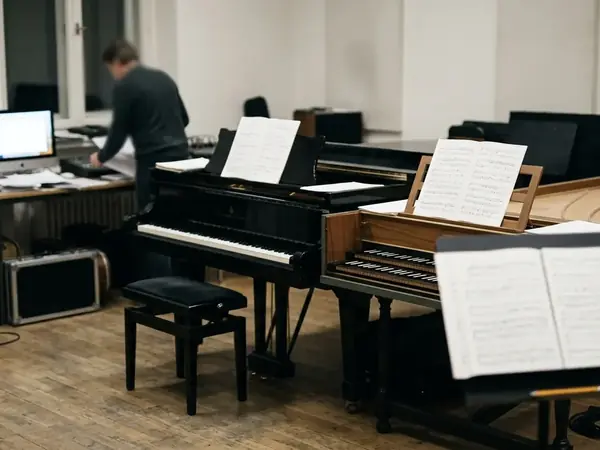
An audiophile-grade classical recording preserves acoustic truth and interpretive vulnerability, with nowhere to hide. Its distinction sits at that precise intersection. When high-fidelity capture strips away the safety net of studio manipulation, the performance stands or falls on what actually happened in the room.
This roster of ten was built accordingly. Candidates were auditioned by complete movements, never by isolated spectacular passages, because the medium rewards musicians who thrive under minimalist microphone techniques rather than those who assemble brilliance from fragments.
In this Article
- Defining the Audiophile Performance
- The Acoustic Challenge of String Instruments
- Criteria for the Roster
- Performances 1–4: Solo and Chamber Intimacy
- Performances 5–7: The Complexity of Ensembles
- Performances 8–10: Orchestral Depth and Dynamics
- The Final Take
Defining the Audiophile Performance
Each candidate had to preserve three things at once: the player's phrasing, the instrument's own voice, and the evidence that a continuous performance occurred. That last item is the one most modern releases sacrifice.
The audition method was deliberate and based on creative process. Useful passages included 20 to 40 seconds of sustained pianissimo, a transition holding at least two bow changes, and the final 10 to 15 seconds after the last chord. Those windows expose noise reduction, edits, unstable imaging, and truncated reverberation faster than any showpiece cadenza could.
Listening happened at two levels. A first-pass review at 72 to 78 dB SPL from the seat, then a quiet pass at 55 to 60 dB SPL to learn whether the phrasing survives without exaggerated upper-midrange detail. If a performance only works loud, it does not work.
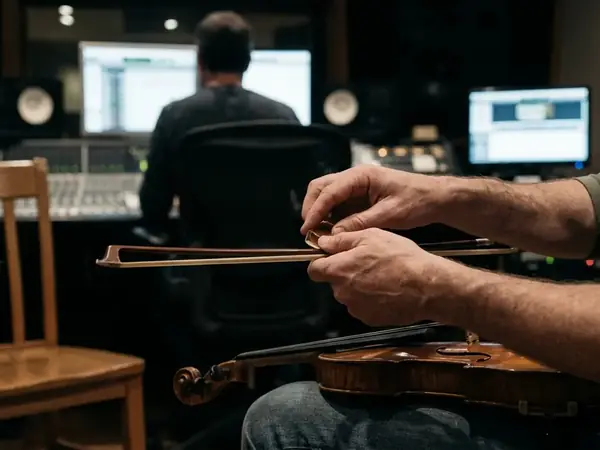
Minimal processing leaves chair movement, breathing, fingerboard contact, and changing bow speed exposed. You can scrub every trace and produce a cleaner file. You also weaken the proof that a human being played the whole thing in one breath.
The Acoustic Challenge of String Instruments
The capture problem divides cleanly into three parts: the source, the room, and the signal chain. Get the framing wrong and the rest follows.
Start with the instrument. The fundamental range sets what the microphones must retain before anyone worries about air or bloom. Then geometry intrudes. A path-length difference of 34.3 centimeters produces roughly 1 millisecond of delay at 20 degrees Celsius; at 1 kHz, a 17-centimeter difference approaches a half-cycle offset and can weaken a centered string image when microphone feeds combine. That is the physics of capturing string resonance asserting itself long before taste enters the conversation.
For a solo violin or cello, placement trials began 1.2 to 2.0 meters from the player and 0.3 to 0.8 meter above the bridge plane. Move closer and bow texture and direct sound increase. Move back and early reflections blend the instrument's separate radiating surfaces.
A close microphone can make bow hair and rosin exceptionally vivid while shrinking the cello's body resonance. Additional detail is not automatic evidence of greater fidelity.
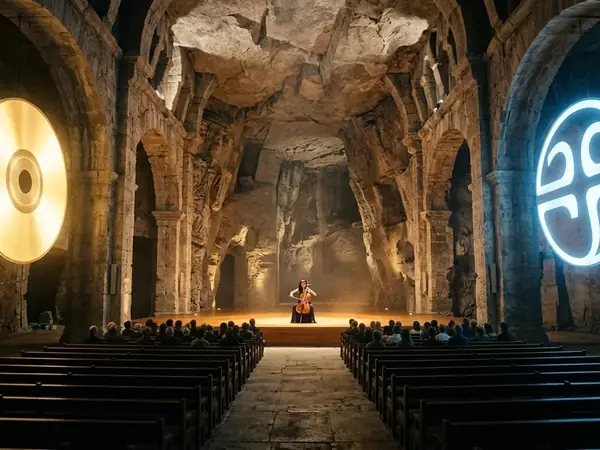
The room is the harder collaborator. A stone church may retain a low-frequency cadence for 3 to 6 seconds even after higher bow harmonics seem to vanish. Editing at the visually obvious end of the waveform therefore shortens the space unnaturally, and the ear notices even when the eye does not.
Note: A visually clean waveform can conceal damaging peak limiting, while a dense uncompressed orchestral passage may look equally crowded. Compression screening should compare several 10-second windows from pianissimo and fortissimo passages. Rising room noise after attacks, flattened transient peaks, or ambience that retreats during loud chords is stronger evidence of gain manipulation than loudness alone.
Criteria for the Roster: Technique Meets Transparency
Selection began with four observable tests: pitch and rhythmic security across an uninterrupted movement, continuity of instrumental position, believable room decay across edits, and an interpretation that holds its shape.
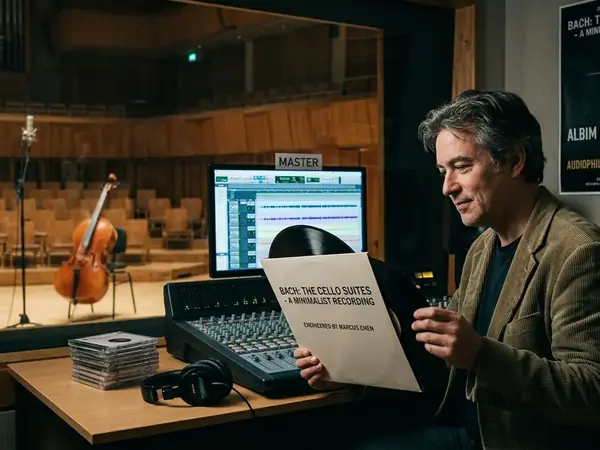
The most revealing review unit is one complete movement, commonly 6 to 18 minutes, because local corrections cannot repair a tempo plan that loses direction halfway through. Where the John Marks Records catalog favored direct-to-two-track production, this constraint became the whole point rather than a limitation to apologize for.
An edit audit inspected 2 to 4 seconds on both sides of every suspected join, watching for changes in chair position, reverberant tail, ventilation hum, or stereo width. A musically clean splice can still relocate the instrument by several centimeters in the reproduced image.
Important context: Purist two-track production sharply limits repair options. Virtuosity established in heavily assembled studio releases does not, by itself, prove that a player can sustain image position, intonation, and emotional continuity through a complete minimally edited take. This roster judges recorded performances through transparency and spatial coherence; it is not a ranking of the musicians' overall careers or of the compositions themselves.
The ten positions landed as follows: Arturo Delmoni in Dvořák's Songs My Mother Taught Me; Nathaniel Rosen in Rachmaninoff's Vocalise; János Starker in the Prelude of Bach's First Cello Suite; Hilary Hahn in Bach's Chaconne; the Takács Quartet in Beethoven's Op. 131; the Emerson Quartet in Bartók's Fourth Quartet; TrondheimSolistene in Britten's Simple Symphony; Marianne Thorsen in Mozart's K.218; Fritz Reiner in Scheherazade; and Charles Munch in Saint-Saëns's Third Symphony.
Performances 1–4: Solo and Chamber Intimacy
The first four entries were chosen where interpretation and microphone exposure become inseparable.
1. Arturo Delmoni — Dvořák, Songs My Mother Taught Me
Audition the approach to each lyrical peak: the timing of the portamento, the narrowing and widening of vibrato, and whether the piano stays behind the violin rather than spreading to the same apparent width. Delmoni's portamento asks for audible continuity between notes without smearing into a slide.
2. Nathaniel Rosen — Rachmaninoff, Vocalise
The reference feature is continuity across bow changes. The phrase must stay intact while rosin contact, left-hand shifts, and the cello's body resonance remain separately intelligible.
3. János Starker — Prelude, Bach Cello Suite No. 1
Recorded during the 1963–1965 cycle. The open-string resonance and articulated bass line give repeatable checks for low-frequency overhang, and for a microphone placed so close that every string crossing becomes disproportionate.
4. Hilary Hahn — Bach, Chaconne
Review the opening 30 seconds, a quiet variation mid-span, and the final minute, all at unchanged playback gain. The interpretation should grow through bow weight and harmonic density, not through an apparent level jump.
Quick Tip: For these four, a 1.2 to 1.8-meter microphone distance is a useful recreation range. A change of only 20 to 30 centimeters can materially shift the ratio of bow friction to body resonance, especially on violin.
Performances 5–7: The Complexity of Ensembles
Entries five through seven were tested for one thing: whether the ensemble kept a readable seating plan during contrapuntal writing.
5. Takács Quartet — Beethoven, Op. 131
Seven connected movements running roughly 40 minutes without conventional applause breaks. That makes the performance a test of tempo memory, cumulative tension, and consistent player placement across the whole span.
6. Emerson Quartet — Bartók, String Quartet No. 4
The pizzicato movement exposes timing differences of only a few milliseconds. The nocturnal textures reveal whether microphone self-noise or aggressive denoising has masked the low-level harmonics.
7. TrondheimSolistene — Britten, Simple Symphony
The Playful Pizzicato movement asks whether many simultaneous plucks keep front-to-back depth instead of collapsing into a bright, flat band.
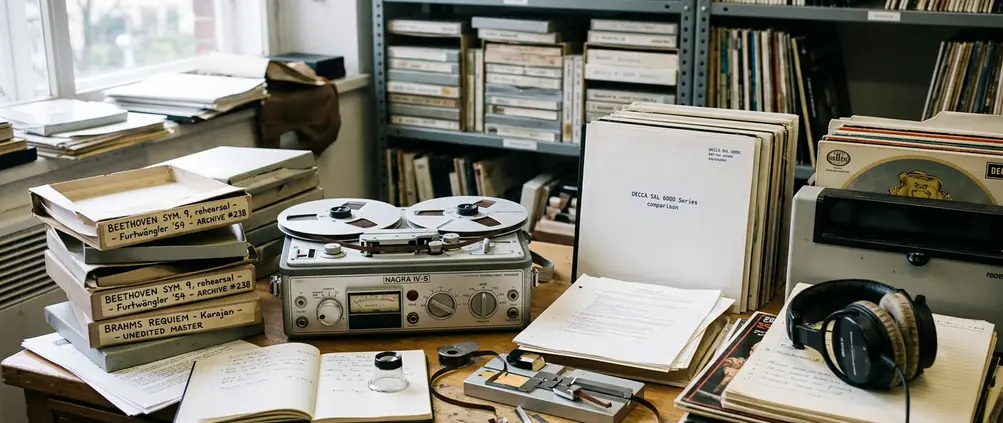
At 20 degrees Celsius, players separated by 1.7 meters create about 5 milliseconds of acoustic travel time before room reflections even enter the picture. Musicians compensate through visual cues, breathing, and anticipation. Try to align every transient electronically and you erase that natural ensemble geometry. A main stereo pair placed 2 to 4 meters in front of a small string ensemble usually captures more coherent depth than spot microphones sitting 20 to 40 centimeters from each instrument; spot feeds get checked for polarity and raised only until a buried line becomes intelligible.
Performances 8–10: Orchestral Depth and Dynamics
The final three scale up the forces while keeping an identifiable string criterion in view.
8. Marianne Thorsen with TrondheimSolistene — Mozart, K.218
Listen to the handoff between soloist and first violins. Their timbres should relate without occupying the identical point in space.
9. Fritz Reiner — Scheherazade
Recorded in 1954. The concertmaster solos give an exposed positional reference; the later tuttis show whether that reference stays embedded in a deeper orchestral field rather than dissolving into a wall of sound.
10. Charles Munch — Saint-Saëns, Symphony No. 3
Recorded in 1959. The organ entry tests sub-bass extension, but the sharper evidence is whether cellos and basses hold attack definition while the sustained organ energy fills the hall.
Capturing an un-ridden orchestral take is a discipline of restraint. Setting the loudest rehearsal peak between −12 and −8 dBFS leaves headroom for a stronger concert attack without an engineer touching the gain mid-movement. A gain move also changes the recorded room noise, and that shift is often audible right across a held chord.
Summary: Conductors shape recorded bloom by releasing a cadence cleanly and preserving 1.5 to 3 seconds of collective stillness before the next entrance. In a more reverberant hall, shortening articulation often clarifies counterpoint better than adding closer microphones.
The Final Take
A damp late-November church. The stone interior is cold and settling slowly. Instruments and microphones have already stood in the performance area for 30 to 45 minutes, so that tuning, condensation, and stand movement have quieted after the drive over.
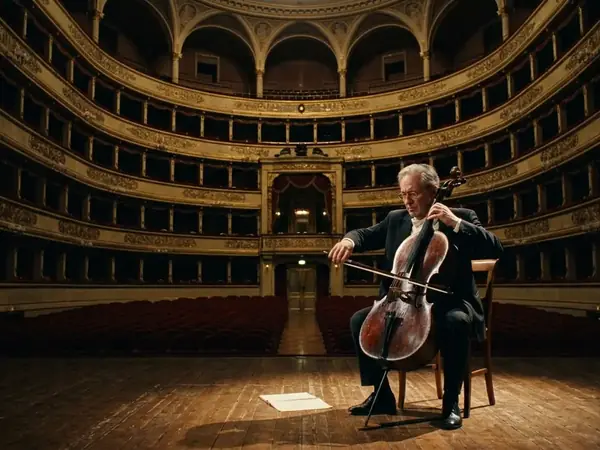
The cellist releases the final chord of the sonata. The bow stays above the string. The left hand holds its place for six, seven, eight seconds. The upper harmonics leave first, thin and quick, while the instrument's lower resonance keeps exciting the whole stone volume.
No one turns a page. No chair shifts. Lowering the bow now would introduce a small clothing or frog-handling sound sitting at nearly the same level as the late reverberant tail, so the bow waits until that tail reaches the stable room floor. The red recording light stays on after the apparent end, and that silence is part of the take: it documents the venue finishing the phrase the player began.