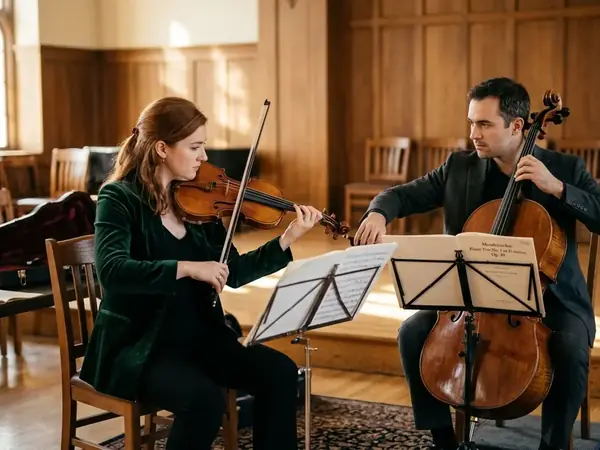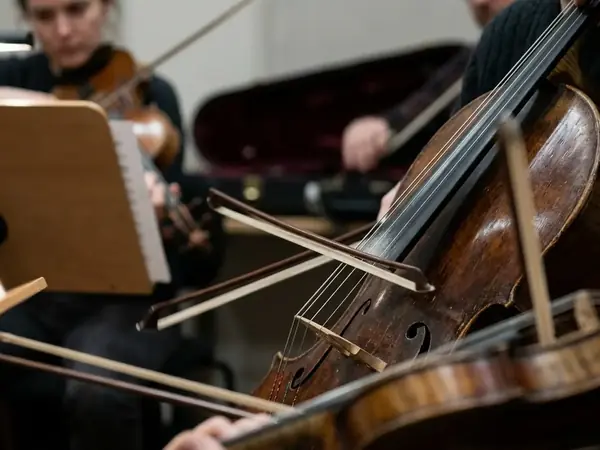
A duo sonata puts two instruments in one room and asks the listener to work out who is leading. The answer changes bar by bar, and in the finest performances it changes faster than most listening habits can follow. The pianist, filed for two centuries under the mild word accompanist, is usually the player deciding when the harmony turns, how long a resonance is allowed to hang, and whether the string line arrives at a cadence supported or exposed.
Three Centuries of Rewriting the Keyboard Player's Job
The clearest way to trace the role is through three practical indicators: what the keyboard player was actually handed, how the music was titled and notated, and what the playback medium allowed listeners to inspect.
In a typical continuo part from roughly 1700 to 1750, the keyboardist received a written bass line plus figures rather than a fully specified right-hand texture. Chord spacing, doublings, ornamentation and rhythmic density all remained performance decisions. That is structural authority, not support work: the player who chooses harmonic density is choosing how much room the string line has to move.
Nineteenth-century virtuoso culture reorganized the billing. Touring soloists sold tickets, programmes named them first, and the keyboard partner drifted toward the wings of public perception even as the scores grew more demanding. Beethoven, Brahms and Franck wrote piano parts that shoulder the argument.
There is a simple score test. Inspect the 8 to 16 bars surrounding a modulation in any of those sonatas and note who moves first. The piano frequently introduces the bass motion, the thematic fragment, or the harmonic redirection before the string instrument completes the phrase.
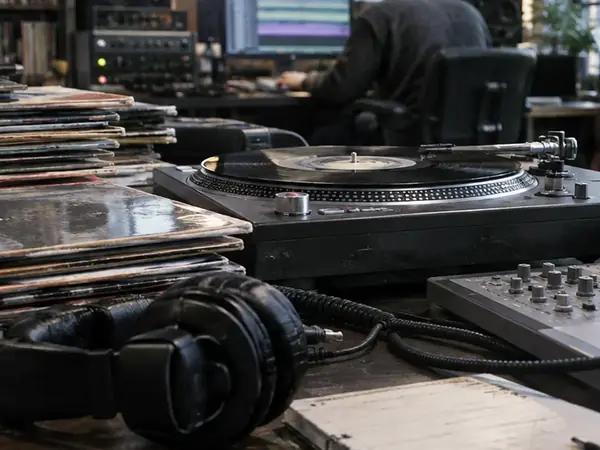
Recording technology settled the question for listeners who never read scores. Between the late 1950s and the mid-1970s, stereo and lower-noise long-playing releases increasingly preserved separate attack, decay and room information from piano and strings, instead of compressing the partnership into a narrow monaural image. Once the two decay envelopes were audible as distinct events in a shared space, the equality composers had notated became something a listener could hear at home.
Bass-Line Custody
Before deciding which player leads a passage, map custody of the bass: identify who owns each modulation, each pedal point, and each cadence. Leadership in chamber music is usually a property of the lowest moving voice, and that voice belongs to the pianist far more often than programme notes suggest.
Voicing Before Volume: How the Piano Makes Room
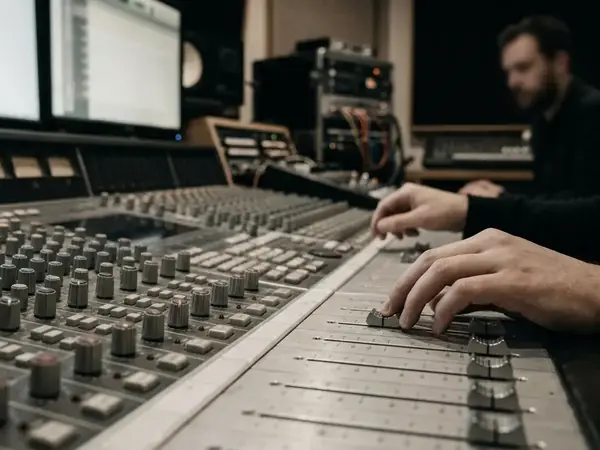
Balance in a duo is a voicing problem first, a microphone problem second, and a fader problem last.
The reason is range overlap. The violin's open G string begins at approximately 196 Hz and the cello's open C string at approximately 65 Hz, while piano fundamentals and overtones occupy both regions comfortably. Playing more quietly therefore does not prevent masking; it only produces a quieter version of the same collision. Register choice, chord density, hammer attack and pedal duration matter more than any broad frequency adjustment.
A master collaborative pianist works through a short sequence: identify the harmonic voice that must project, take weight off doubled inner notes, shorten the pedal wherever bass resonance accumulates, and shape the attack so that the string entry is met rather than covered. The mismatch between a percussive hammer strike and a bowed sustain is managed by timing the release, not by retreating to a permanent mezzo-piano.
Placing the Pair
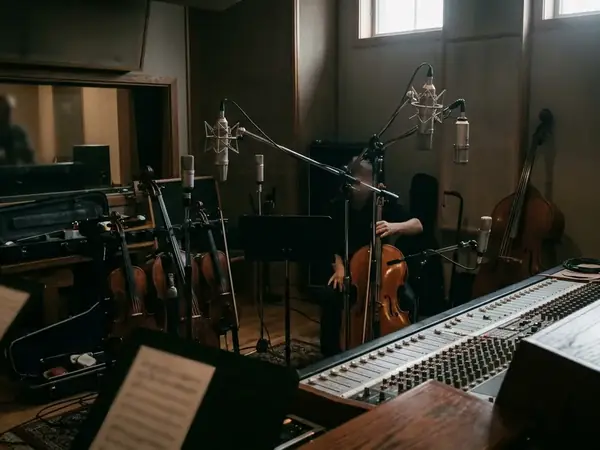
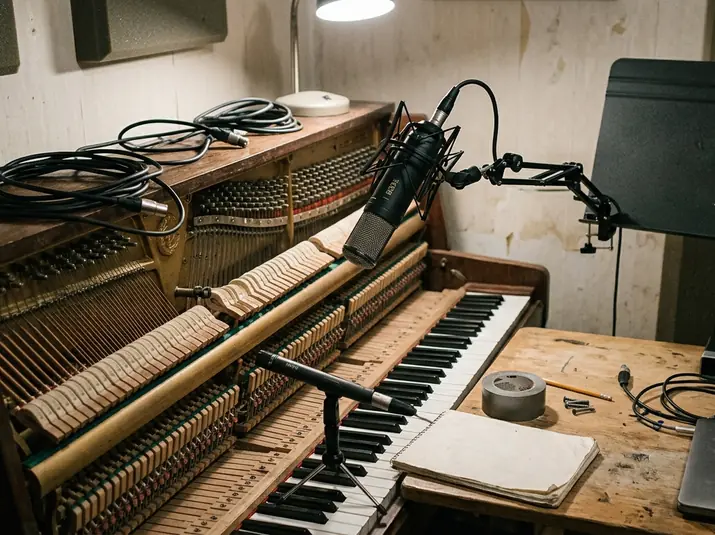
For a natural chamber perspective, an initial microphone trial can place the main stereo pair roughly 2 to 4 m from the duo and 2 to 3 m above the floor, followed by 20 to 40 cm adjustments once bass buildup, lid reflections and image width have been checked. Where support microphones prove necessary, starting distances of roughly 0.8 to 1.5 m preserve more instrument body than very close placement. Their level should be raised only until articulation survives quiet playback, and stopped well before either instrument appears acoustically detached from the hall.
The Shared-Room Boundary
In sessions from the late 1950s through the 1970s, conspicuous left-right assignment could produce a stable stereo demonstration while weakening the audible impression that both players shared the same early reflections and the same reverberant tail. Treat hard separation, close-microphone attack and mastering level as recording variables before crediting every apparent change in partnership to the performers themselves.
Cue, Response, Recovery: The Rhythmic Engine
Shared rubato deserves evaluation at the phrase level rather than against a metronomic grid. The useful sequence runs cue, response, recovery: one musician lengthens an arrival or compresses a transition, the partner decides whether to follow immediately or hold tension against it, and both re-establish the underlying pulse before the next structural point.
The quantities involved are tiny. At quarter note equals 60, a displacement of 20 to 40 ms occupies only a small fraction of the one-second beat, yet it can make an appoggiatura feel suspended, a bass entry feel urgent, or a cadence feel reluctant, all without producing anything a listener would call a wrong note.
Rehearsal can expose whether that flexibility is genuinely shared. Isolate a 4 to 8 bar transition and play it three times: once with the pianist leading, once with the string player leading, once with no leader named. Comparing where the pulse recovers reveals whether the rubato is negotiated or merely copied by the second player a beat late.
Editing carries the same obligation. Listening to the 10 to 20 seconds before a disputed entrance preserves the physical cue and the harmonic preparation that explain it; judging the splice point alone tends to reward mechanical simultaneity over a convincing phrase. Recordings with sufficient room detail may preserve a breath roughly 0.5 to 1.5 seconds before an entrance, which lets the listener connect preparation, attack and response as one gesture. That level of retained detail is precisely what a catalogue built around string playing of the calibre of violinist Arturo Delmoni and cellist Nathaniel Rosen exists to protect, and it is the reason John Marks Records has favoured natural hall perspective over engineered separation.
The Continuo Realization as a Directing Decision
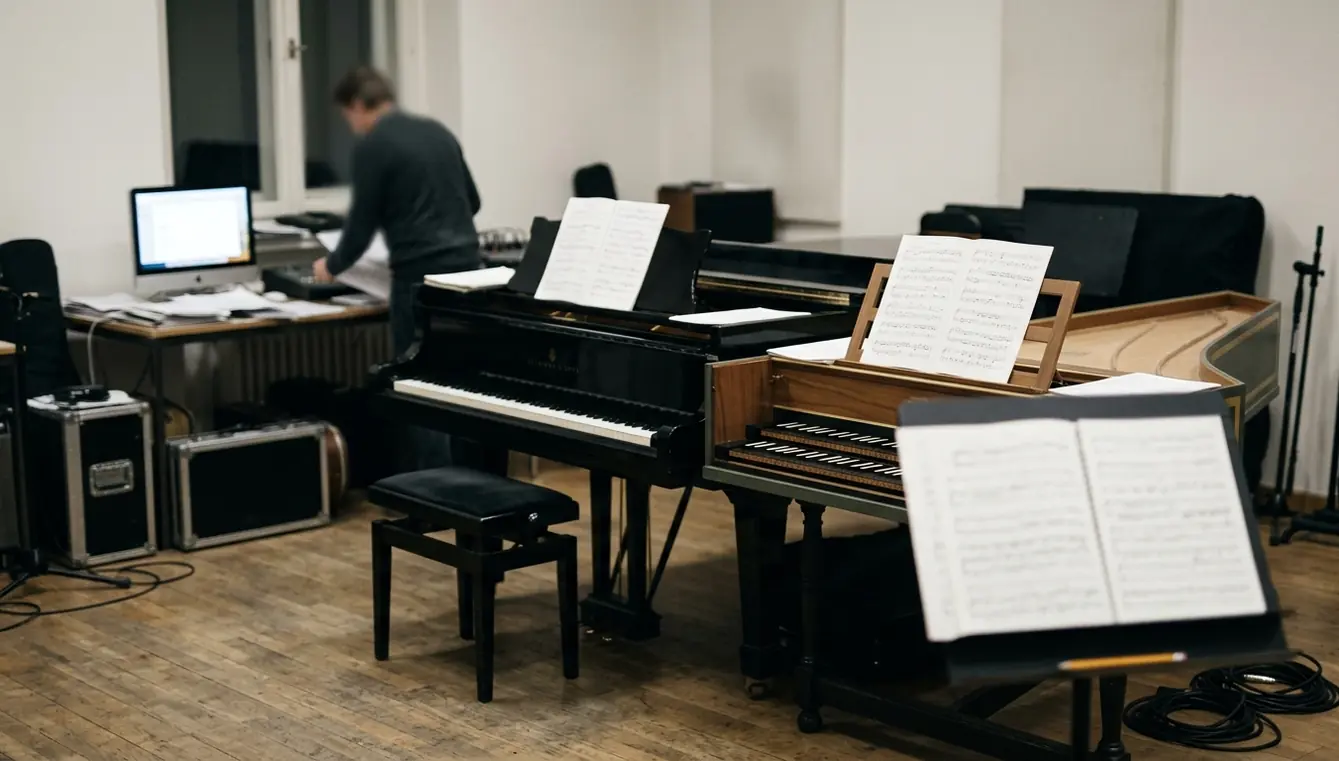
Move back to Baroque and early Classical repertoire and the partnership becomes explicitly improvisational. The continuo player reads bass motion and figures, weighs cadence strength and dissonance, then decides how many upper voices to supply, where to place them, and whether rhythmic activity should reinforce the string line or leave air around it.
A realization may shift within a single 8 to 12 bar phrase from sparse sustained intervals to four-voice chords at the cadence, changing harmonic weight and, with it, the string player's room for ornamentation. The violinist's phrasing is not merely accompanied by these choices; it is redrawn by them in real time.
Pitch standard compounds the effect. For repertoire performed at A=415 rather than A=440, the sounding pitch is approximately one equal-tempered semitone lower, which alters string tension, instrument resonance, tessitura and the continuo player's registration choices together.
Tuning Drift Window
The harpsichord's sharp transients demand patience at setup. A microphone trial can begin around 0.7 to 1.2 m from the case rather than directly over the jacks, with subsequent 10 to 20 cm moves used to reduce key and plectrum prominence while retaining definition against gut strings. During a 2 to 3 hour session, re-check the harpsichord-string blend after the first 15 to 25 minutes: temperature, tuning drift and player acclimatization routinely undo the balance agreed at setup.
A Listening Protocol for the Next Free Evening
Reserve 25 to 40 minutes and choose a violin or cello sonata already familiar enough that the melody will not hijack attention. Spend 8 to 15 minutes on one complete movement, uninterrupted, to restore its large-scale shape.
Give the second pass the same span, and ignore the melody as far as concentration allows. Trace the piano's left hand, or the continuo bass, through pedal points, chromatic descents and cadential preparation. Note where the harmonic foundation moves ahead of the string line.
Then spend the remaining 9 to 10 minutes comparing two performances of the same work. Select three windows of 30 to 60 seconds — an opening statement, a modulatory transition, and a cadence or coda, and begin each window from the same musical bar in both recordings. Match playback loudness before judging anything, because even a small level advantage makes one piano seem clearer and more rhythmically assertive. Keep volume, listening position and loudspeaker settings unchanged across the swaps.
Restrict yourself to four observations per excerpt: who initiates the tempo change, where the bass releases, how long the piano resonance overlaps the string line, and whether both players reach the cadence together or in expressive sequence. The comparison identifies the audible partnership rather than an uncontaminated cause, since two releases may differ in string player, edition, instrument, hall, microphone perspective and mastering all at once.
Pull two recordings of the same sonata off the shelf tonight, cue both to the identical bar of the first modulation, match their levels, and write those four observations down before the second playback ends.