Most listeners audition a string recording the way a proofreader reads a manuscript: hunting for errors, rewarding the take with the fewest of them. That habit misses almost everything interesting. A performance captured with minimal intervention is a document of choices accumulated over decades of practice rooms, competitions and concert halls, and those choices survive in the grooves long after the artist has stopped playing the piece that way.
What follows is a structured method for hearing them.
In this Article
- The Blank Slate Performer Does Not Exist
- Hearing a Teacher's Fingerprints in a Bow Change
- Wood, Gut and the Room That Answers Back
- Three Passes Through the Same Sixty Seconds
- Working Through the Prelude: A Session You Can Repeat
The Blank Slate Performer Does Not Exist
The definitive audiophile string recording is rarely the cleanest one. It is usually the take where an artist's training rubs against the acoustics of a particular room and neither one wins outright. You hear the friction: a bow change that refuses to disappear because the player was taught that the line matters more than the seam, a decay that runs longer than the engineer might have liked because the hall had opinions of its own.
Modern listening culture treats a classical release as a sealed, sterile event. Track eleven, 4:32, mastered loud enough to survive earbuds. Yet the same performer recorded the same repertoire at twenty-five and at fifty-five, and those two documents disagree in ways that are audible if you stop counting blemishes.
The John Marks Records approach — drawn from a catalogue built largely around solo and small-ensemble string playing, with violinist Arturo Delmoni and cellist Nathaniel Rosen among its recurring artists — starts from a preference for uncompressed, lightly edited capture. Treat that preference as a listening question rather than a promise about every release. Put on the first thirty to sixty seconds of a sustained passage, then the same passage from a different recording at the same playback level, and let the comparison settle the matter.
Decay or Hiss?
After a phrase ends, the instrument's sound should hand off to room decay. Learn to separate that decay from tape hiss or an air-handling rumble. If you cannot hear the handoff, either the venue was small and dry or the transfer has been gated. Both are worth knowing before you draw conclusions about the artist.
Hearing a Teacher's Fingerprints in a Bow Change
Start with the documentation, not the ear. Release notes, program biographies and competition records name teachers and early repertoire. Only after that does the listening test mean anything: does the playing show recurring habits consistent with that training, across pieces and across years?
Three phrase openings give you a usable sample. Mark a soft entry, a strongly accented entry, and an entry that follows a rest. Then compare, on adjacent phrases:
- Bow pressure at the onset of the note. Is weight applied before the string speaks, or does the sound arrive first and thicken afterward?
- Vibrato timing and width. Does it begin with the note or arrive a beat late as an expressive decision?
- Where the player takes time. Before a leap, at the top of a phrase, or on the resolution?
Repertoire choice tells its own story. A debut disc tends to display the techniques an artist had drilled to the point of public confidence during the formative years, which is a hint about priorities rather than a proof of influence.
And here the honest limit of the method: bowing and vibrato cannot establish a particular conservatory lineage without corroborating biographical evidence. Where a performer's documented teachers and a recurring articulation habit point the same direction, the connection is worth stating. Where only the ear suggests it, keep it as a hypothesis.
Wood, Gut and the Room That Answers Back
Identify the instrument from the credits if it is named. A Guarneri, a Gofriller, a modern commission — the release notes will say, or they will not. Inferring a maker from tone alone is guesswork dressed as expertise.
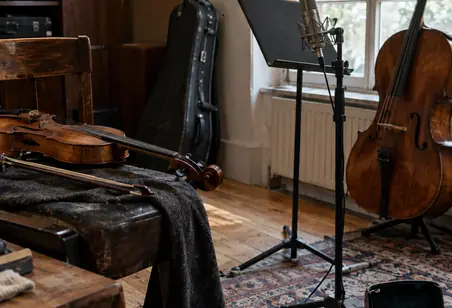
With the instrument established, trace two notes. Take one low open-string passage and one passage high on the upper strings, audition both at the same volume, and follow each from bow attack through the body of the instrument into the room. At every note ending, compare the immediate woody resonance with the later, more diffuse sound of the venue. That single exercise separates what the string produced from what the wood added and what the microphone position and the hall contributed on top.
Venue selection carries as much weight as microphone choice in this kind of capture. A bright, wiry violin in a reverberant stone church reads as glare; the same instrument in a mid-sized hall with warm early reflections reads as focus. Where a label's session notes document which rooms hosted which artists, the pairing logic becomes checkable rather than mythological. Anyone curious about how those reflections behave will find the field of architectural acoustics well documented.
Three Passes Through the Same Sixty Seconds
Room, physical technique and interpretation will compete for your attention if you try to hear them at once. Separating them into passes solves that. Choose a continuous passage of 60 to 90 seconds and replay it three times without touching the volume control.
- The environmental pass. Ignore the playing. Listen for room tone, apparent microphone distance, and the decay of the final note. Leave three to five seconds after that note before stopping playback so the tail stays audible.
- The technical pass. Locate bow changes, position shifts, fingerboard noise and any audible breathing. Log them as physical mechanics, not as faults.
- The interpretive pass. Describe pacing and articulation in plain language first, then check any proposed lineage against the documentation you gathered earlier.
Level Discipline
Set the volume once, at the start of the session, so the instrument sounds plausible from a seated audience position. Every comparison afterward depends on that constant. Nudging the dial between takes converts an evaluation into a preference for whichever one was louder.
Working Through the Prelude: A Session You Can Repeat
Here is the whole method compressed into one evening, using the Prelude from the first solo cello suite as the test passage. It is unaccompanied, harmonically transparent, and recorded often enough that comparisons are easy to source.
Preparing the system
Power the amplification and let it reach thermal stability according to the manufacturer's guidance. Then set the reference level: play the opening measures and adjust until the cello sits at a believable size for a mid-hall seat, neither miniature nor stretched across the room. Write the setting down. Do not touch it again.
Two replays of four measures
Cue the Prelude's first four measures and play them twice.
On the first replay, take the opening arpeggio apart into its three stages. Bow contact: the instant the hair engages the string, before the pitch stabilises. Cello-body resonance: the woody bloom that follows, belonging to the instrument. Room decay: the diffuse tail that belongs to the venue. Name each one aloud if it helps; the boundaries become obvious after two or three attempts.
On the second replay, drop the mechanics and follow the pulse. Notice where the player stretches the descending line, whether the rubato is applied to the arrival note or to the approach, and whether the bow change at the end of each measure preserves the line or deliberately articulates it. Then, and only then, open the biography. If the artist studied with a teacher known for a particular approach to the suites, ask whether what you heard supports that connection or merely permits it.
The log entry
Close the session by dating a log: release and transfer used, playback level, passage location, what you actually heard, and any biographical source consulted. Six months later, that entry lets you repeat the identical test on a different pressing of the same performance and know exactly what changed.
A Prelude Log Entry
A sample entry for the first four measures:
- Environmental pass: “The last note leaves a brief room tail.”
- Technical pass: “The bow change at the end of measure four is audible.”
- Interpretive pass: “The player holds back before the descending line resolves; the biography does not establish a link between that choice and a teacher.”