In this Article
- One Creak, One Collapsed Hall: Why a Stereo Pair Hears Everything
- Rumble Beneath the Viola: Ducts, Trucks, and Pedal Thumps
- Creaks, Bow-Hair Ticks, Sniffs, and the Page-Turn Reflection Train
- Quieting the Stage Before the Red Light
- Prevent, Tolerate, or Splice: Deciding What Stays in the Master
One Creak, One Collapsed Hall: Why a Stereo Pair Hears Everything
A single wooden chair creak during a suspended cadence can undo an evening of careful audio engineering. On a resolving playback system, the listener's attention leaves the ensemble's apparent position in the hall and lands on the physical stage: a chair, a body shifting its weight, a room with seats in it. Ventilation rumble does slower damage. It fills in the quiet foundation of the space until the hall stops sounding like a hall.
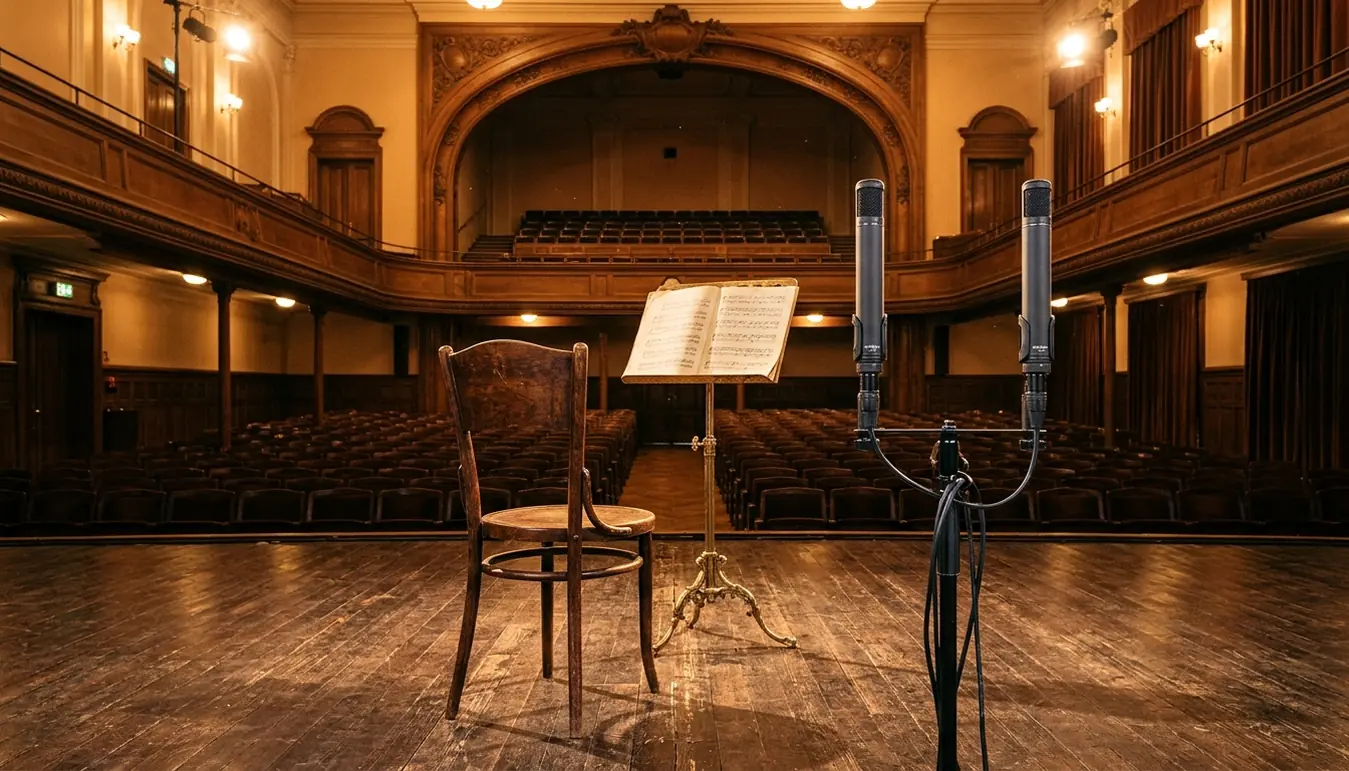
The microphone geometry explains why this happens, and the digital format has little to do with it. A purist array, often a single stereo pair of omnidirectional condensers, hears the room from every direction at once. Nothing sits close to the instruments to lift the music above the room, and no artificial reverb arrives later to wash over the gaps. Whatever reaches the pair becomes part of the recording at the same ratio as the violin itself.
Solo and chamber string repertoire makes the problem sharper. A pianissimo decay fades gradually into the hall's own noise floor, and that fade is part of the music. A 24-bit recording cannot reduce acoustic noise already reaching the microphones; its wide recording range simply preserves the quiet decay and the unwanted background disturbance together, side by side, with equal fidelity.
A Simple Room Assessment
- Seat the performers and record 30–60 seconds of occupied-stage silence.
- Have them play one soft chord, then capture 10–15 seconds of listening as it decays.
- Record both at the intended microphone position and the actual performance gain. Raising gain only for the test makes the room sound noisier, relative to the music, than it really is.
- Check the captured tail on headphones and on full-range loudspeakers. Headphones expose small ticks; loudspeakers with extended bass reveal disturbances that compact monitors tend to underrepresent.
Rumble Beneath the Viola: Ducts, Trucks, and Pedal Thumps
Low-frequency intrusions arrive by two broad routes, and the remedy depends on which one is active. Airborne rumble comes from air-handling ductwork and grilles. Structure-borne vibration travels through the building: distant truck traffic shaking the foundations of a historic church, or the mechanical thump of a piano or harp pedal carried across a wooden stage floor.
Sorting them out is a methodical job. Record the same occupied room with ventilation running and then stopped, leaving microphone position and gain untouched. Compare the low-frequency spectrum and listen for changes in duct noise. Isolated swells that line up with passing vehicles point outside the building; repeated impacts that track the pedalling point to the stage. Inspect roughly 20–80 Hz for sub-bass disturbances, and keep listening above that band for turbulence and rattling grilles. A spectrum display shows energy, though only the ears and a log of events can name its source.
Why Sound Below the Strings Still Matters
The violin's lowest open string sits at approximately 196 Hz, the viola's at approximately 131 Hz. Engineers sometimes treat anything beneath those pitches as harmless. It costs plenty. Sub-bass rumble occupies converter headroom, loads the playback woofer, and can modulate high-frequency string texture through intermodulation distortion in loudspeakers. Listeners with full-range subwoofers feel it as a vague fatigue long before they can name it.
Pedal thumps deserve particular care. A thump can travel through the stage, enter a microphone stand mechanically, and radiate acoustically from the floor itself. An isolation pad under the stand addresses the second path and leaves the other two alone.
The Climate-Control Gamble
Switching off the air handling sounds like an easy win, yet a rising or falling room temperature can pull gut and synthetic strings off pitch between takes. Run a trial first: compare 60–90-second recordings in each operating state, log the temperature near the players every 5 minutes during the shutdown, and track tuning after each complete take. Gut and synthetic strings respond differently to temperature, humidity, and the movement of the instrument body, so no universal correction or fixed time to instability applies.
Headroom Before Silence
If the shutdown trial shows tuning drifting faster than the ensemble can comfortably correct, a steady, well-documented ventilation hum may be the better compromise than a silent room full of wandering pitch.
Creaks, Bow-Hair Ticks, Sniffs, and the Page-Turn Reflection Train
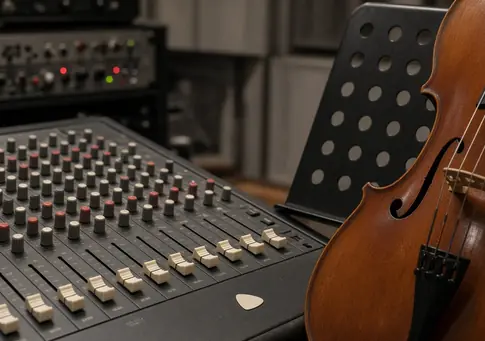
Higher up the spectrum live the human artifacts. Weight shifting on wooden folding chairs. Loose or snapped rosin-coated bow hairs ticking against the string. Sharp inhalations before an upbeat, audible sniffs, throat clearing. The dry rustle of a heavy paper score.
Each one should be classified by its source and its musical function before anyone calls it a defect. Breath is the clearest case. In a string quartet, a shared inhalation communicates phrasing and attack timing, and listeners hear the ensemble agreeing on a downbeat. A nasal sniff or a cleared throat carries no such information and pulls the ear out of the musical line.
Gathering reference examples helps. Ask the seated player to reproduce ordinary weight shifts, have the group rehearse the relevant page transition, and capture 10–20 seconds of each at performance microphone gain. These staged samples make the sounds recognizable later in the edit, without standing in as proof of what happened in a released take.
How a Hall Stretches a Click
At approximately 343 metres per second, an additional reflected path of 3–10 metres produces a delay of roughly 9–29 milliseconds. A sharp tick therefore reaches the microphones as several closely spaced arrivals before the later reverberant tail even begins.
Picture a quartet holding a final chord when a page falls. The editor removes the paper impact cleanly, and the early reflections of that impact still cut across the chord's decay. A page turn unfolds as a sequence of friction sounds and impacts, so selecting only its highest waveform peak leaves the surrounding rustle and its reflections in place.
Bow-hair ticks need a different kind of patience. Deliberate bow attacks and incidental hair contact can occupy overlapping frequency regions, so compare a suspected tick against the score and against repeated performances of the passage before touching it.
Quieting the Stage Before the Red Light
Every remedy in this section works outward from the physical source, long before equalization enters the conversation. These steps reflect recommended practice in purist classical production, the kind of preparation the high-fidelity string recordings associated with John Marks Records reward on playback.
- Book a noise rehearsal. Allocate 15–25 minutes of occupied-stage time before final sound checks, covering chair movement, score handling, endpin stability, and pedal operation wherever a keyboard or harp is present.
- Test every chair under real movement. Tighten, appropriately lubricate, or replace any noisy chair with venue approval.
- Inspect bows before the downbeat. Players remove stray hairs while keeping normal bow articulation fully available to the music.
- Stage the scores. Lay out single sheets in reading order, rehearse any unavoidable turn, and add felt at score-contact points without blocking sightlines.
- Decouple the stands sensibly. Choose isolation pads for the supported load and stable footing. Density alone says little about isolation, and an overly stiff pad may attenuate almost nothing.
- Anchor the cello. An endpin anchor should stop slipping and stay mechanically stable. Any compliant support also changes the instrument's coupling to the floor, so the cellist should judge its effect on response before the session.
Choosing the Quiet Hours
Late-night sessions are a long tradition for delicate solo passages, since municipal traffic thins out. Compare candidate windows with 2–3-minute ambient samples at the same microphone position, and include the building's overnight ventilation state. Quieter streets sometimes coincide with conspicuous plant noise that cycles on after hours.
Prevent, Tolerate, or Splice: Deciding What Stays in the Master
The order matters: prevent first, tolerate second, edit last. Repeatable mechanical noise gets fixed while the session is still running. Unobtrusive human presence that belongs to the phrasing stays. A conspicuous disturbance sends the engineer to a matching safety take before any spectral reconstruction, checking intonation, bow direction, tempo, and the state of the hall decay at the proposed splice point.
Splicing Between Safety Takes
Try 20–100-millisecond crossfades as an initial audition range for well-aligned material, then shape the boundaries to waveform continuity and room decay. The replacement passage must carry compatible reverberation into the splice. A perfect match on the direct attack can still leave the preceding harmony's tail chopped short.
Auditioning a Spectral Repair
Loop a 3–6-second passage containing the event and its surrounding decay, then replay the complete phrase. A repair that sounds tidy in isolation can still sound wrong in context. Judge it for missing overtones and altered reflected sound as well as any residual noise.
Filters That Eat Cellos
A cello's lowest open string is approximately 65 Hz, so a high-pass filter set near 80 Hz can attenuate musical fundamentals along with the rumble. Assess the filter's slope and response, not just its cutoff label. After broadband noise reduction, listen for watery modulation, softened bow texture, and a noise floor that rises and falls with the music.
Over-processing strips away exactly what defines a reference-grade audiophile recording: the air around the instruments, the grain of rosin on gut, and the low-end bloom of the hall itself.
Consider a solo violinist's preparatory inhalation sitting in the same stereo capture as the previous note's ringing harmonics. Removing the breath would hollow out that resonance, because both share the same microphones and the same moment. The breath stays.
Keep the Living Take
Never apply spectral repair or high-pass filtering to erase a performer's breath or a slight chair shift if the process compromises the harmonic decay of the string. Choose the untouched, emotionally transcendent take, with its trace of human mechanics, over a clinically scrubbed edit every time. Listeners forgive a breath; they never forgive a hall that has stopped ringing.