What a Bowed Note Asks the Recording to Keep
What exactly is lost between rosin gripping a string and the final master file of a classical recording? The answer often begins before the note has settled. A bow catches, releases a brief scrape, and sets the instrument’s wooden body vibrating. The room answers a moment later. Those sounds belong together, yet each has a different shape and a different vulnerability in the recording chain.
Listen to the first 10–50 milliseconds of a bowed note, then to its sustained portion. The onset carries friction and direction; the body supplies pitch, weight and changing overtones. A smooth sustained tone can sound convincing even when the attack has been flattened. Conversely, an etched attack can draw attention while leaving the instrument itself strangely thin.
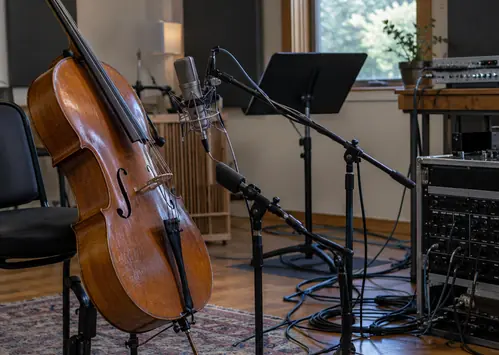
That balance matters whether the instrument is a violin in Arturo Delmoni’s hands or a cello played by Nathaniel Rosen. The microphone receives a combination of direct sound and hall reflections. A preamplifier raises its level. The converter turns the resulting voltage into samples, and the recording system writes those samples to a file. Each stage acts as a lens on the same performance: it can retain the relationship between bow, body and room, or make one part harder to hear.
A useful test passage lasts 20–40 seconds. Follow a player through an exposed entrance and into a sustained phrase, then listen past the release. Can the initial scrape, wooden resonance and hall response still be distinguished? That question gives the rest of the signal-chain discussion a purpose. It asks what a component preserves in a musical event, rather than how impressive it looks on a specification sheet.
Giving a Quiet String Microphone Room to Breathe
The microphone preamplifier faces a demanding assignment: lift a small microphone signal to a workable line level without obscuring the quiet passage or crowding the loud accent. A distant passive ribbon may produce only hundreds of microvolts during soft playing. An active condenser in the same room will commonly deliver more. The gain setting must answer the microphone and the performance, rather than the preamp’s reputation.
Set Gain at Both Ends of the Phrase
Start with the quietest passage that must remain useful in the finished recording. Then ask for the strongest expected accent. In a quiet, distant setup, a passive ribbon may require roughly 50–65 dB of gain; an active condenser may need roughly 25–45 dB, according to its sensitivity and placement. Check the converter during the forceful passage and leave peaks roughly 6–12 dB below digital full scale. This leaves space for an unexpected emphasis without sacrificing the soft material to an unnecessarily low setting.
Solid-state and tube preamps offer different choices. A fast, low-distortion solid-state design tends to keep the leading edge of a violin stroke clear. A tube stage may add a subtle harmonic character that gives a cello an appealing sense of density. Neither description settles the choice on its own. Compare the same microphone position at matched playback levels, attending to the attack and the body together. If warmth arrives with a softened entrance, the trade-off should be audible and intentional.
Cello Phase Trap
A premium preamp can preserve complex cello overtones, but it cannot repair phase cancellation between a poorly placed close microphone and the main pair. Check their relationship in the live room before judging the electronics.
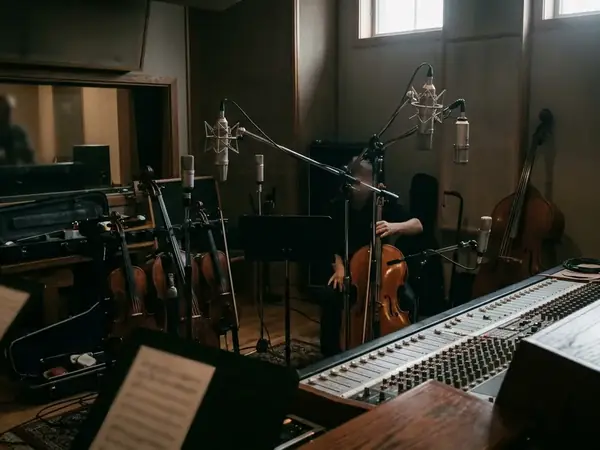
This is the chain’s first important boundary: gain and harmonic character shape a signal that the microphone has already captured. Moving a microphone can change the balance between direct sound and room more profoundly than exchanging preamps. Once that placement is settled, the preamp can be judged for its own contribution.
Where the Hall Becomes Digital
At the analog-to-digital converter, continuous voltage becomes digital data. The most revealing material is often quiet: the fine return of a hall after a violin attack, or the way a quartet’s final chord loosens into reverberation. These cues give a recording its sense of depth. Before comparing converter settings, verify that its analog input receives the intended level; a level mismatch can overwhelm a subtler difference in conversion.
Clock Behavior and the Edge of a Bow Stroke
A clean, stable sampling clock helps keep low-level reverberation free of clock-related artifacts. Absolute clock accuracy and short-term jitter describe different things, so a single clock specification cannot stand in for a listening result. The practical question is whether the returning hall remains smooth and locatable, particularly after the direct sound has begun to fade.
Filter choice deserves the same measured treatment. For minimalist classical recording, a linear-phase conversion filter is a defensible option because it maintains frequency-dependent phase relationships. Engineers who favor it want the position and shape of a sharp violin attack to survive conversion intact. Yet a linear-phase filter can have its own time-domain behavior, including pre-ringing. The appropriate comparison is between actual filter settings in the same chain, rather than between filter labels.
Record a comparison at 24-bit and a chosen sample rate such as 96 kHz. Keep microphone placement and analog gain unchanged between filter auditions. A 10–30-second passage with exposed violin attacks followed by a quiet decay provides a manageable test: locate the attack, then follow where the hall seems to return. If one setting makes the onset seem cleaner while the room becomes less coherent, listen again at a matched level before deciding which quality matters more for that performance.
The Long Walk from Hall Floor to Control Room
Classical recording often puts the microphones where the music breathes and the recorder somewhere else. A cable may cross the hall floor, pass through a stage box and continue to the control room. Measure that route first. Choose sound connectors and balanced microphone cable, and make sure the route keeps the line clear of obvious interference sources. Cable length becomes a useful engineering question once the physical path is known.
Capacitance deserves attention because it forms a low-pass network with the microphone’s output impedance. Consider a 60-metre run rated at 80–120 pF per metre. Its capacitance is approximately 4.8–7.2 nF. With a 200-ohm source, a simple RC calculation places the cutoff at approximately 110–166 kHz, above the audible band. That example draws a useful line between a plausible wiring problem and the claim that a long balanced run automatically removes a viola’s highest overtones.
Before Blaming Length
Inspect connectors and termination, listen for interference, and check the microphone’s source impedance before attributing audible dullness to cable capacitance. The calculation describes a particular source and run, not every microphone-and-input combination.
Shielding protects a different part of the performance. It helps reject electromagnetic interference that can intrude most clearly during a soft passage or a long decay. Balanced inputs also reject noise common to both signal conductors. A well-made run should let a quiet bow change remain quiet on its own terms, without hum or buzz drawing a line through it. When trouble appears, checking the route and its connections offers a more precise remedy than treating cable length as a tonal control.
Let the Quartet Expose the Chain
A resolving playback system makes small recording decisions easier to hear, but it also makes comparisons easier to misjudge. Hold playback level fixed. A louder version can appear to have sharper attacks and greater detail even when the musical relationships have changed little. Use a familiar passage and listen for events rather than for a component’s supposed signature.
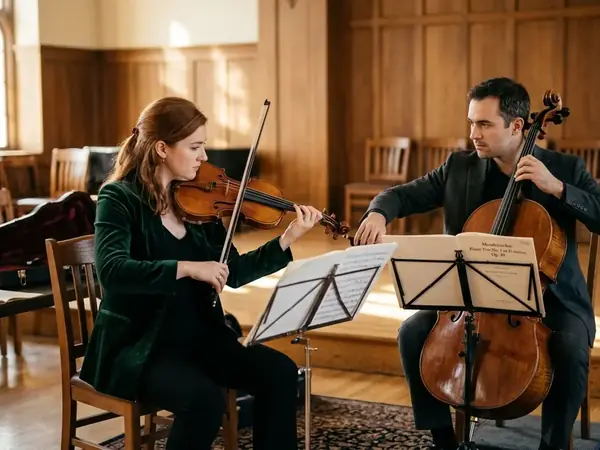
Begin inside the ensemble. When neighboring players share a phrase, their bows may move together while their instruments keep distinct bodies and positions. The recording should allow those players to remain identifiable without forcing a hard outline around each one. Listen next to a release. Over the 2–4 seconds after a quartet’s final note, the hall should recede from recognizable reverberation toward silence. A tail that turns grainy or vanishes abruptly warrants another listen to the same passage at the same level.
These markers connect playback to decisions made earlier. A crowded entrance may point back to microphone placement or gain; an unstable sense of room may invite a closer converter comparison; hum during the decay sends attention toward the cable route. Playback identifies a question for the recording chain to answer. It cannot, by itself, convict a particular component.
Three-Part Listening
Follow the bow-grip onset, the wooden-body bloom and the hall-tail decay as separate events within one note. Their relationship is more revealing than an isolated impression of brightness or warmth.
For John Marks Records, that relationship is the heart of an audiophile string master: a performance whose physical detail remains connected to the acoustic space around it. Select a familiar, uncompressed string quartet recording, turn off all DSP and equalization, and replay a 20–40-second exposed passage while listening for the physical texture of the bow engaging the string before the note fully blooms.