In this Article
- Which Recording Best Introduces Each Principal String and Keyboard Artist?
- Arturo Delmoni: Solo Violin Architecture and Warmth
- Nathaniel Rosen: Uncompressed Cello Resonance and Scale
- Transients, Brass, and Pipe Organ: Beyond the Solo String Palette
- Setting Playback Gain and Acoustic Focus for Your First Audition
Which Recording Best Introduces Each Principal String and Keyboard Artist?
When facing an archival catalog of purist classical recordings, which single disc best captures each principal artist's temperament and tonal signature? The question sounds simple. In practice, a listener confronting the John Marks Records archive meets violin, cello, early brass and organ titles with little guidance on where any one artist's character is most fully exposed.
The most reliable sorting method is musical exposure. Unaccompanied violin reveals bowing and voicing. Exposed cello reveals articulation and the balance between registers. Ensemble and organ repertoire reveal acoustic scale, the sense of a large space filled with sound. Each category stresses a different part of a playback chain, so each gets its own entry point here.
The production philosophy behind these audiophile recordings shapes what a listener hears. The label's stated approach favors minimalist microphone arrays, natural concert hall and church acoustics, and the avoidance of dynamic compression. That approach preserves transient attack and room decay, and it also leaves nothing to hide behind. A system that softens or exaggerates a frequency region will do so audibly.
One caution about evidence. A two-microphone recording supplies two captured channels, but that fact alone establishes nothing about microphone spacing, phase behavior, or whether compression entered during mastering. Original booklet credits remain the best documentary source for microphone and venue details, and they record intentions more often than measurements.
Scope of the Shortlist
The shortlist below names one entry-point disc per principal artist with multiple catalog appearances or a landmark solo release. Ensemble recommendations stay separate from keyboard-artist recommendations. The complete archive is wider than this guide, and the tonal judgments here are listening judgments: electrostatic and dynamic loudspeakers, room reflections and bass integration can each shift the perceived balance of the same uncompressed transients in a home room.
Match Soloist Level
Compare the same 30–60-second passage on successive auditions, and match perceived soloist level rather than keeping the volume control in one position. Louder playback reliably sounds "better" in quick comparisons, which skews every other judgment.
Arturo Delmoni: Solo Violin Architecture and Warmth
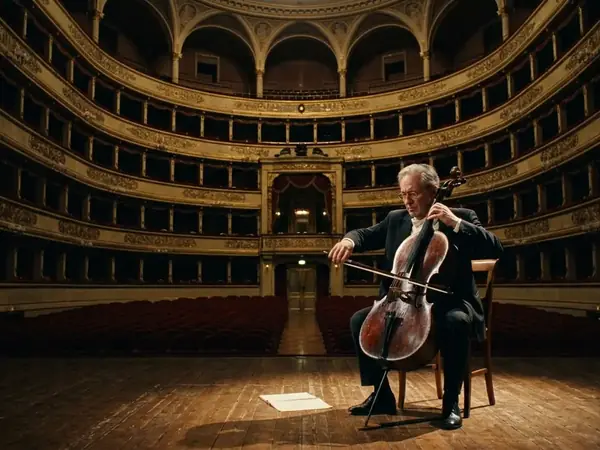
Start with Delmoni's solo program pairing Ysaÿe, Kreisler and J. S. Bach. Removing the piano exposes the relationship this violinist handles best: melodic warmth held inside a firm structural frame.
His playing belongs to an older Romantic lineage. The tone is warm and rounded, the portamento expressive, and the bow pressure noticeably more restrained than the aggressive attack common in modern solo playing. Underneath sits a disciplined rhythmic spine.
Those two qualities are easy to confuse, so it helps to follow a single phrase through to its arrival note. Portamento concerns the audible connection between pitches, the slide that links one note to the next. Rhythmic discipline concerns whether expressive stretching still preserves the larger pulse. Delmoni can lean into a slide and land the downbeat where the bar expects it. In Bach, that combination keeps the polyphony legible; in Kreisler, it keeps sentiment from turning sticky.
How the Recording Frames the Instrument
The engineering places the violin in an intimate, warm acoustic, favoring the wood resonance of his historic Italian instrument over spotlit high-frequency bow noise. Listeners accustomed to close-miked violin may initially hear this as soft. Give it a few minutes.
Warmth has a physical basis, though it resists simple reduction. The open G string has a fundamental near 196 Hz at standard concert tuning, yet the perceived wooden body of the instrument involves additional body resonances and harmonics well beyond that single frequency. A system with a lean lower midrange will rob Delmoni of exactly the quality that defines him.
- Choose a 20–40-second passage containing double-stops.
- Let the silence immediately following the phrase play through.
- Listen for where the played sustain ends and the room's decay begins.
- Check image height from the normal seated position, without moving the speakers between comparisons.
A convincingly elevated violin image is a playback observation. It says nothing definitive about the microphone's physical height.
Nathaniel Rosen: Uncompressed Cello Resonance and Scale
Rosen's Bach solo-cello recording is the entry point. A Tchaikovsky Competition gold medalist, he brings a large, centered tone and the patience to let Bach's dance movements breathe. His duo recordings of Romantic repertoire, including the program issued as Reverie, are rewarding second purchases; before buying either, confirm the edition and suite contents against the track list, since boutique reissues sometimes differ in contents.
The case for the Bach comes down to clarity of evidence. In unaccompanied writing, the transition from bow onset to sustained pitch is far easier to follow than in a passage reinforced by piano bass. Every note's life cycle is on display.
Recording a cello well is a balancing act. Capture too little of the room and the instrument loses its chest resonance; capture too much and the lower midrange blooms, smearing articulation. The open C string sounds at approximately 65.4 Hz, with its second harmonic near 130.8 Hz. Bass evaluation must therefore cover both the fundamental region and the lower midrange, because a hump at 130 Hz can masquerade as depth.
C-String False Grandeur
An enlarged cello image is easy to admire and easy to misread. Separate the roughly 65.4 Hz fundamental, its harmonic around 130.8 Hz and the room tail before calling a bigger presentation faithful. Excess room energy can make a lean instrument sound monumental.
Subwoofer Integration and Its Limits
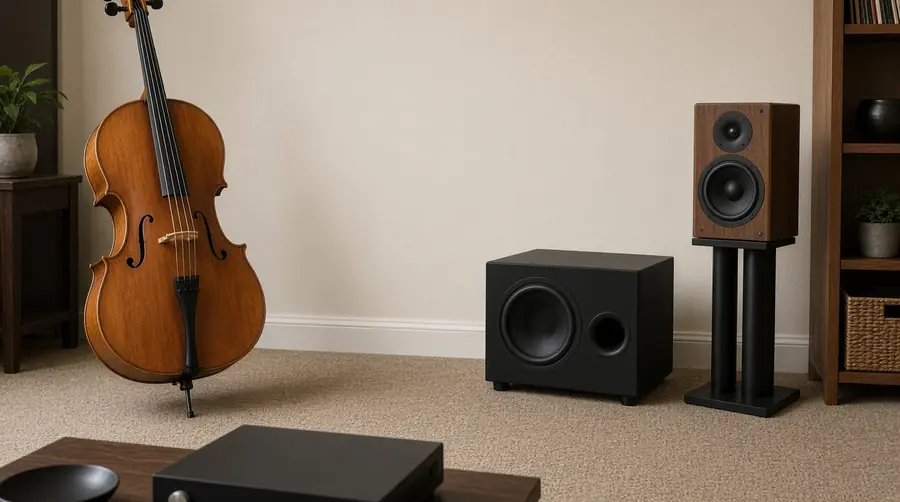
Purist captures of this kind can deliver striking phase coherence and spatial realism, but they place real demands on the low end. Low-level ambient hall rumble sits beneath the cello, and the playback system must resolve it without thickening the fundamental pitch. Full-range transducers or a carefully integrated subwoofer are the practical requirement.
A direct test settles most arguments:
- Replay a 15–30-second low-register phrase with the subwoofer engaged, then bypassed, keeping main-speaker level unchanged.
- Judge note-to-note distinction, and resist choosing whichever version carries more weight.
- Listen in sequence for bow contact, the establishment of pitch, and the remaining room tail. Each is a separate audible component, and each tells you something different about cello size.
Transients, Brass, and Pipe Organ: Beyond the Solo String Palette
The Boston Shawm and Sackbut Ensemble and the archive's pipe organ recordings work as complementary scale tests. They are different tools, and treating them as interchangeable recommendations misses what each one exposes.
Shawms are double-reed instruments; sackbuts are early brass. Their blended attacks test far more than brass power alone, because the reedy edge and the rounder brass onset arrive together and must stay distinct. Judge ensemble separation during sustained harmonies, where weak systems collapse inner voices into a single buzz.
The dynamic envelope here differs sharply from solo strings. A violin phrase swells and recedes within a modest range; a full ensemble chord or an organ tutti can push sound pressure levels far higher, and the label's engineering lets those peaks stand without brickwall limiting. That is the payoff and the risk. Rough sound at a climax may come from instrumental beating, recording overload, loudspeaker intermodulation or room effects, and audible roughness alone cannot identify which.
Organ recordings raise a separate question: what is actually down there? A nominal 16-foot low C sits near 32.7 Hz; a 32-foot low C sits near 16.4 Hz. Before expecting bottom-octave content, confirm the instrument's stop specification and whether the music uses the pedal at all. Identify the actual release and credited organist, too, before settling on a keyboard entry point.
Delmoni-to-Organ Boundary
A stable solo-violin image proves nothing about pedal capability at about 16.4 Hz, and neither observation verifies the archive's microphone or compression history. Each disc answers its own question about your system.
Silver Discs Versus Lossless Transfers
Physical pressings from boutique audiophile labels go out of print cyclically, so many listeners now compare surviving original discs with lossless digital transfers. Recorded-sound preservation is a recognized archival concern; the Library of Congress National Recording Preservation Board exists partly because such material disappears without deliberate care.
For a fair comparison, identify the mastering first, then use the same DAC and the same reconstruction-filter setting for both sources. A different mastering can outweigh any difference attributable to the delivery format. Choose a 20–40-second passage with simultaneous sustained parts and switch at matched level.
Setting Playback Gain and Acoustic Focus for Your First Audition
Expect these discs to sound quiet at first. A wide-dynamic-range master leaves generous headroom, so it can sound softer than a densely limited commercial recording at the same control position. No fixed offset follows from the label or repertoire; the right level depends on the passage and the room.
A Level-Matching Protocol
- Reduce playback gain before starting.
- Cue an exposed mezzo-forte phrase of 30–60 seconds featuring the soloist.
- Raise the level until the instrument reaches plausible acoustic scale, the size a real violin or cello would occupy a few meters away.
- Audition a louder 15–30-second excerpt to check headroom and comfort.
- Set gain on the soloist's playing, never on the background noise floor. Raising level until room noise becomes conspicuous overshoots the climaxes.
Refining the Center Image
Adjust both speakers symmetrically in approximately 2-degree toe-in steps, replaying the same phrase after each change. Stop when the center image holds steady without squeezing the violin or cello into an unnaturally narrow point. Over-focusing is a common mistake; a real instrument has width.
Pick one disc tonight based on your system's strongest region: Delmoni for midrange harmonic density, Rosen for low-end articulation, or the shawm-and-sackbut and organ titles for soundstage depth. Cue the opening track with your preamp approaching a setting somewhere near 3 to 4 dB above your usual pop/rock level, raising toward it from below, then hold that gain for the first uninterrupted movement and adjust toe-in until the soloist settles into a stable, three-dimensional center image.
References
- Original John Marks Records booklet credits for microphone, venue and instrument details