Why Identical Masters Can Behave Differently in an Optical Player
When the digital master of a solo violin or string quartet session is bit-for-bit identical, what physical mechanisms inside an optical disc cause measurable differences in transport jitter, laser reflectivity, and long-term archival stability?
The investigation begins by separating recovered audio data, optical tracking behavior, and the player's handling of timing. A pressing can demand more corrective work from a transport while delivering exactly the same audio samples. Correctable read errors leave those samples unchanged. Uncorrectable errors may cause interpolation, muting, or an audible interruption, depending on the player.
That distinction matters when a sustained violin note seems to acquire a different texture. The listening impression deserves examination; assigning it immediately to the pressing skips the evidence needed to explain it. Timing variation in disc reading does not, by itself, establish timing variation at the digital-to-analogue converter.
The CD reached commercial release in 1982; SACD followed in 1999. For collectors of boutique classical releases, including those from the publishing label John Marks Records, that history frames questions about playback compatibility and edition identity. Those dates do not establish the label's own release chronology or prove that a particular title moved between formats.
Compare Corresponding Audio Layers
Red Book audio carries 16-bit PCM at 44.1 kHz. Conventional SACD uses a 2.8224 MHz, 1-bit DSD stream. These encodings require separate treatment: a claim of bit identity belongs between corresponding layers or files, rather than between PCM and DSD representations.
For a CD-layer comparison, retain extraction checksums, drive identity, retry reports, and track boundaries together. A matching checksum documents recovered data. Reflectivity, servo effort, and playback timing require their own evidence. This separation keeps an investigation of a quartet recording focused on what each observation can actually establish.
Inside the Hybrid Disc's Two Optical Planes
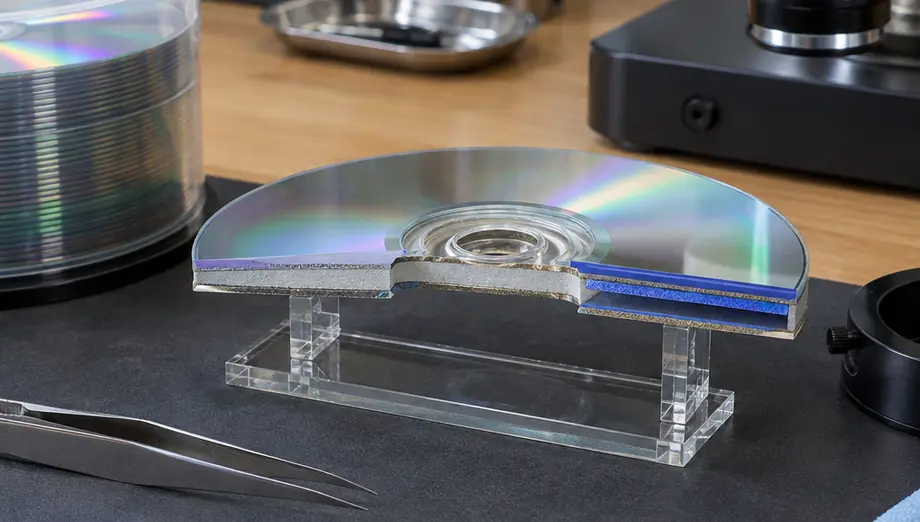
Viewed edge-on, a hybrid SACD appears almost uneventful: a thin, bonded disc whose optical complexity lies beneath the surface. Follow the reading laser inward from the entrance face and the construction becomes easier to understand.
A conventional CD has an approximately 1.2 mm polycarbonate substrate. A hybrid SACD combines two approximately 0.6 mm substrates with a thin bonding layer between them. Its high-density information plane sits approximately 0.6 mm from the reading surface; the CD information plane lies farther away, approximately 1.2 mm from that surface.
Why the Intermediate Coating Matters
The farther CD plane commonly uses aluminum. The intermediate coating has a more selective task: it must reflect enough light at the SACD reading wavelength while transmitting enough at the CD wavelength. Gold and silicon-based coating systems are examples; neither should be assumed from a disc's appearance alone.
CD reading uses an approximately 780 nm infrared laser, while SACD high-density reading uses an approximately 650 nm red laser. The hybrid therefore asks its coatings and substrates to support different optical paths through the same physical object. That arrangement creates a compatibility challenge for some pickups, even when the encoded programme remains recoverable.
Bonding quality also deserves precise language. Adhesive nonuniformity, substrate tilt, and residual molding stress are distinct manufacturing variables. A variation in UV-cured bonding resin thickness may alter optical geometry; thickness variation alone does not establish birefringence. Birefringence concerns the material's polarization-dependent refractive behavior, so its presence and magnitude require separate assessment.
Coating Color Limits
A warm tint cannot authenticate a coating recipe or demonstrate superior sound. Record visible discoloration as a condition observation, and keep material identification separate from visual description.
Reading Hub Inscriptions Without Inventing a Pressing History
The matrix band can establish a useful manufacturing trail. Its evidentiary reach stops well short of the recording session.
In the conventional replication chain, a photoresist-coated glass master is exposed and developed, then used to produce an electroformed nickel father. A mother follows, providing the intervening replication stage for production stampers. The father and production stamper carry relief features complementary to the molded disc's pits. This sequence explains how a master becomes a production tool; it does not supply a universal decoding key for every hub suffix.
Transcribe Before Interpreting
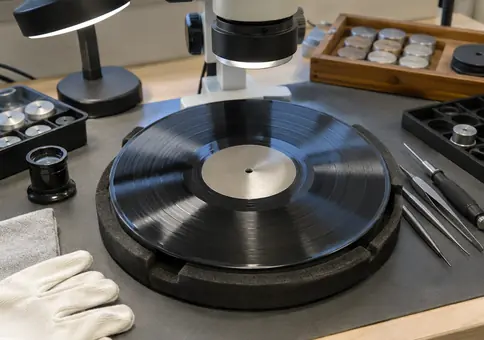
- Support and illuminate the disc. Use oblique light and a 5×–10× loupe. Rotate the disc under the light rather than pressing an inspection tool against its surface.
- Photograph the matrix band. Capture every readable character adjacent to the clamping area, including spacing and punctuation. Keep the transcription separate from any proposed interpretation.
- Separate the SID fields. Mastering SID codes commonly begin with IFPI followed by L and additional characters. Mould SID codes normally appear in the clear hub plastic and use a different character pattern.
- Compare the documentary record. Match the catalog number and matrix text with original liner notes, booklet mastering credits, and dated session or production records where available.
- Record the strength of the attribution. Reserve a first-run designation for an edition supported by corroborating production evidence.
SID codes were introduced in 1994. Their absence on an earlier disc is therefore chronologically unsurprising. Undocumented suffixes cannot reliably identify father, mother, or stamper generations, even when a collector's proposed sequence looks orderly.
A booklet may identify Arturo Delmoni as violinist or Nathaniel Rosen as cellist. That performance credit belongs beside, but remains distinct from, manufacturing evidence. Likewise, a mould SID may support a manufacturing-source attribution; it cannot identify the converter used to capture the quartet.
A useful catalog gives matrix text, mastering SID, mould SID, catalog number, booklet mastering credit, and dated first-run evidence their own fields. Separating these entries preserves uncertainty without losing detail.
Testing Hybrid Discs in High-Mass Optical Transports
A heavy chassis or substantial clamping mechanism does not establish hybrid compatibility. Recognition depends on the pickup's optical design and control behavior. The intermediate coating changes the path to the CD plane, and some CD-only transports struggle to acquire a usable signal through it.
The information planes are separated by approximately 0.6 mm. Describing that spacing as unusually tight offers little diagnostic value. The useful question is where playback fails: initial recognition, table-of-contents reading, sustained playback, or track seeking.
A Repeatable Recognition Check
- Confirm the player's documented disc compatibility and layer-selection setting. A relay click alone does not identify the selected layer.
- Test an ordinary CD and the hybrid's CD layer in the same transport, using three cold-start trials per disc. Record recognition time and each failure without imposing a universal pass threshold.
- Listen for repeated seeking or clicking during initialization without obstructing the mechanism. Treat these sounds as observations rather than proof of a particular fault.
- Check the hybrid in a second compatible machine. Compare recognition, sustained playback, and seeking to distinguish disc-specific behavior from transport-specific behavior.
Disc geometry contributes another variable. Center-hole eccentricity makes the recorded path wander relative to the spindle axis; runout increases the tracking or focus correction demanded during rotation. A conventional 1× audio CD runs at approximately 500 rpm near the inner programme area and approximately 200 rpm near the outer area. SACD mechanisms use different operating speeds and buffering strategies, so speed-related conclusions require knowledge of the actual transport.
Preserve Spindle Balance
Avoid stick-on damping rings, edge paint, and improvised clamps. Added mass, imbalance, contamination, or altered clearance introduces another fault variable—precisely what a controlled comparison should exclude.
Keeping Hybrid Pressings Stable on the Shelf
Preservation starts with the storage location. An interior shelf away from sunlight, radiators, and exterior-wall cycling offers a more manageable environment than a display position exposed to daily heating and cooling.
The Library of Congress compact disc preservation guidelines, within its guidance on audiovisual materials, support cool, relatively dry, stable storage and careful handling. A practical room-storage target is 16–20 °C and 35–45% relative humidity. These are operational targets, rather than a verbatim Library of Congress specification or a prediction of disc lifespan.
Log temperature and relative humidity at 30–60 minute intervals for 7–14 days. That record exposes cycling a single reading would miss. Stable conditions help limit moisture- and temperature-related deterioration affecting substrates, bonding materials, and metallic layers.
Inspect Foam Before Reshelving
Older multi-disc cases warrant an inspection beneath the discs. Check polyurethane foam for crumbling, tackiness, discoloration, and transferred residue. Photograph its original position before removing deteriorating material, and retain printed inserts separately. Do not assume that every mark on a disc is chemical etching: record the visible condition before assigning a cause.
- Lift each disc by its outer edge and center opening without bowing the bonded substrates.
- Remove loose dust before wiping. For fingerprints, use a soft, lint-free cloth lightly dampened with clean water.
- Wipe radially from the hub toward the rim, never around the track spiral.
- Store discs upright in clean, supportive cases, with deteriorating foam removed.
- Keep secure CD-layer extractions and checksums alongside matrix photographs and condition notes.
Pair Sound With Provenance
An extraction preserves a recoverable audio baseline; a hub photograph identifies the physical pressing associated with it. Keeping both makes future comparisons more useful than either record alone.
For the next hybrid pressing admitted to the collection, will the purchase rest on a first-pressing description, or on a readable matrix, corroborating edition records, and a documented playback check?