In this Article
- What Does the Print on an Audiophile Disc Actually Tell You About the Sound?
- Spine Numbers, Tray Cards, and the Inscriptions in the Mirror Band
- From Church Floor to Glass Master: Decoding Venue, Microphone, and Mastering Credits
- Building a Collector's Ledger That Another Listener Can Retrace
What Does the Print on an Audiophile Disc Actually Tell You About the Sound?
When you inspect the spine, matrix ring, and booklet of a high-fidelity string recording, which printed details directly explain the sonic character you hear through your speakers? The answer follows a sequence. Session and engineering credits describe how the sound was captured. Mastering credits describe what happened to it afterward. Disc markings describe the physical object that carries it.
In minimalist audiophile production, the booklet functions as an engineering logbook. A note stating that a violin sonata was captured with two omnidirectional microphones records a specific decision that a listener can investigate and test against what reaches the listening chair. A phrase such as "natural sound" records an intention. Serious collectors transcribe the two kinds of statement separately, because only the first can be checked.
The problem is that this logbook is disappearing. Streaming metadata routinely drops session dates, microphone placement, and mastering lineage. For many audiophile recordings, the physical booklet and the disc itself remain the only primary record of how a performance was put onto tape or into a converter.
A second confusion compounds the first. A standard audio CD carries two-channel linear PCM at 16-bit resolution and a 44.1 kHz sampling rate. That figure describes the delivery format of the disc. It says nothing certain about the format of the original session.
Spine Numbers, Tray Cards, and the Inscriptions in the Mirror Band
Every string disc carries three separate kinds of evidence. The spine catalog number identifies the marketed edition. The inner mirror band holds manufacturing evidence. The booklet documents the session and production chain. Most cataloging errors come from merging these three into one record.
Catalog Sequence as a Map of a Label's Thinking
On a boutique classical label, sequential catalog numbers can trace the evolution of a recording philosophy. Arrange the releases by number, then place documented session and publication dates beside each one. Annotate repertoire, venue, and engineer. Patterns emerge quickly: a shift from solo violin to string quartet, a move to a new church, a change in balance engineer. The sequence is a hypothesis about chronology, so the dates must sit next to it rather than be inferred from it.
What the Tray Card Says Versus What the Disc Says
Read the spine and tray card first. Here you find the barcode, the distributor's code, and format badges that distinguish a Red Book CD from a hybrid high-resolution release. A hybrid disc contains a conventional CD layer and a separate high-density layer, and that layer configuration deserves its own note, apart from the catalog number and barcode.
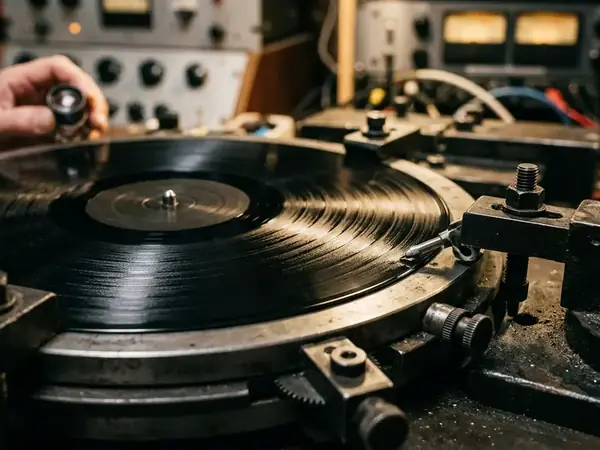
Then tilt the disc under oblique light and read the inner mirror band. The characters there were introduced during mastering and replication. Calling them "matrix inscriptions" is more accurate than assuming each character was individually laser-etched onto the finished disc.
Plant Identifiers and Stamper Codes
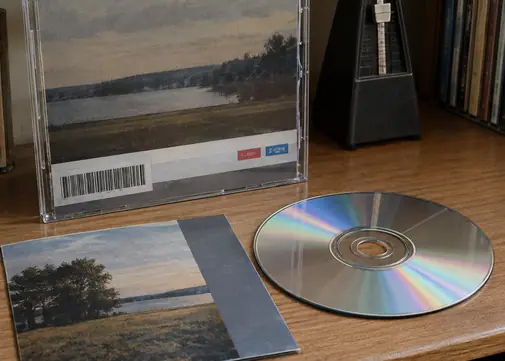
Within that mirror band, two codes matter most. A mastering SID code, commonly beginning with L, points to the glass-mastering stage. A mould SID code relates to the replication tooling. Any additional plant, job, or stamper string should be logged as a separate observation. Comparing these across copies is how collectors begin to separate an original pressing from a later reissue.
Matrix Codes Have Limits
Pressing marks establish stated provenance. On their own, they cannot prove that a reissue carries a different mastering or that one pressing sounds better, so confirm any such claim by listening under matched conditions before recording it as fact.
From Church Floor to Glass Master: Decoding Venue, Microphone, and Mastering Credits
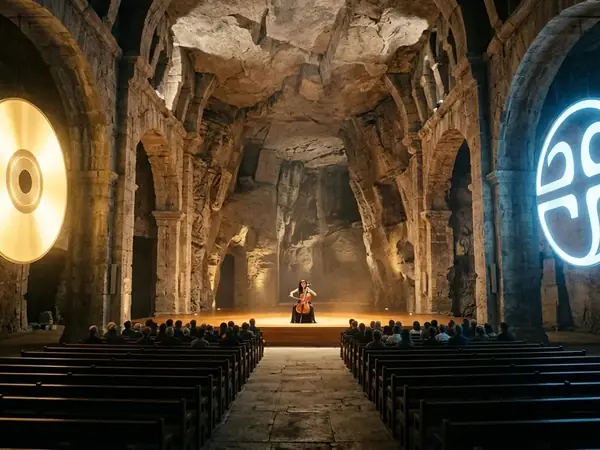
The venue credit is the most acoustically revealing line in the booklet. Boutique producers name the exact church, hall, or recital room because that enclosure shapes everything the microphones receive. A solo violin in a large stone nave develops a long reverberant tail; the same player in a modest recital room sounds drier and closer.
The word "church" alone predicts very little. Decay depends on room volume together with absorption and occupancy. When a booklet quotes an RT60 figure, the time associated with a 60 dB decay in sound level, check which frequency band and occupancy condition it refers to. A mid-frequency value leaves the room's bass behavior undescribed, and bass behavior is what governs the weight of a cello's lowest string.
Who Did What in the Credits Block
- Producer: artistic direction and oversight of the session.
- Recording or balance engineer: microphone choice, placement, and the capture of the balance.
- Editor: assembly of takes into the finished performance.
- Mastering engineer: final preparation of the release.
On small labels, one person often holds several of these credits. Preserve the combination exactly as printed, since a producer who also balanced the session represents a different working method from a divided team.
Reading the Signal Chain Before You Press Play
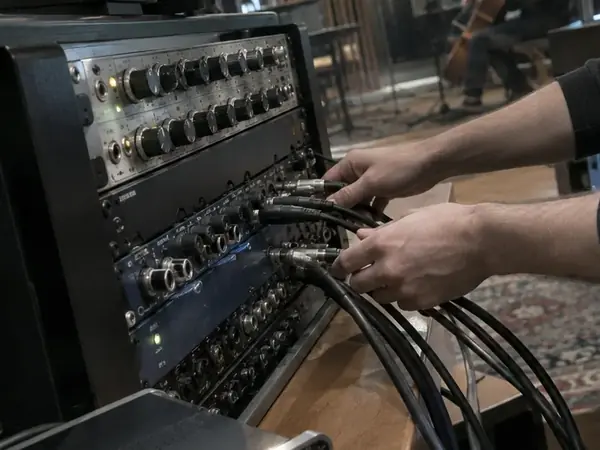
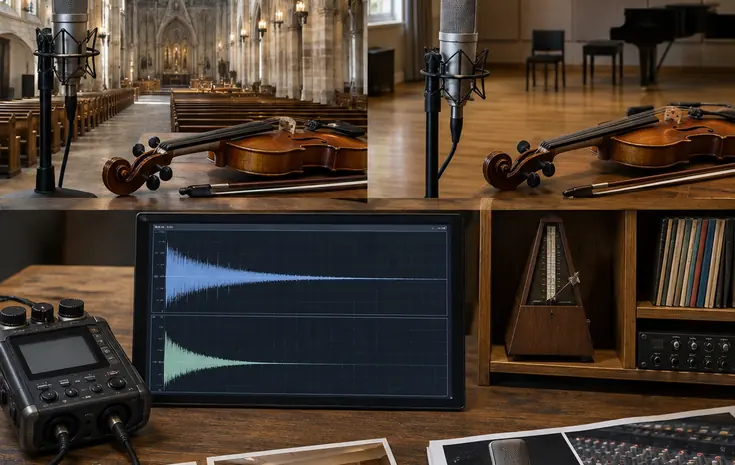
For a spaced pair of omnidirectional microphones, look for capsule spacing, distance from the ensemble, height, and any mention of supplementary microphones. Record measurements in their original units. Microphone position and directivity govern the balance between direct string tone and reflected room energy, which is where your expectations about soundstage depth should start.
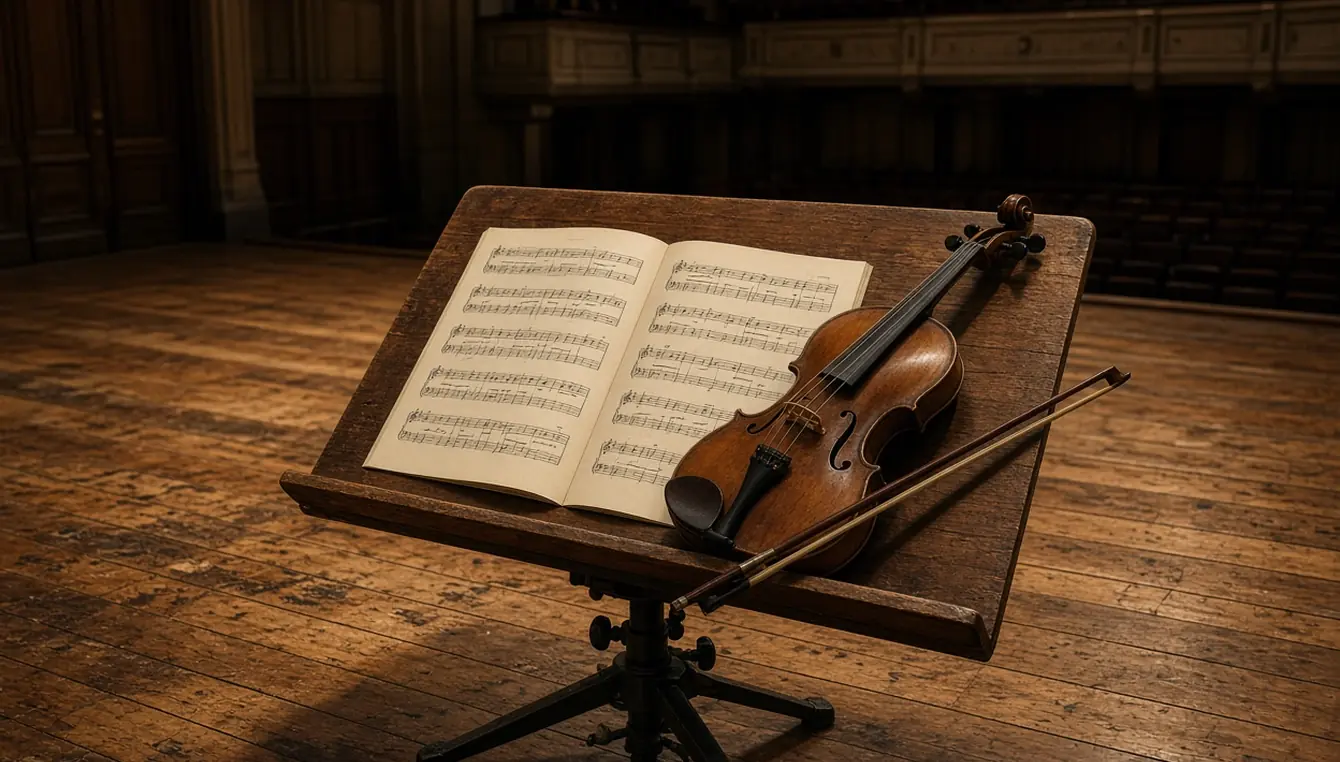
Converter notes need the same care. A 24-bit, 96 kHz credit describes acquisition or an intermediate production format, while a conventional CD edition still delivers 16-bit, 44.1 kHz audio. Instrument credits deserve verbatim transcription too: "attributed to," "workshop of," and "school of" carry real meaning, and the bow maker belongs in a separate entry from the violin, viola, or cello maker.
The credited violin maker and the two-microphone diagram form the recording's documented acoustic blueprint. Soundstage depth and bow texture remain your own listening observations, and a good archive keeps them in a different column.
Building a Collector's Ledger That Another Listener Can Retrace
An archive earns trust when someone else can follow every conclusion back to a photograph or a page. This workflow builds that trail.
- Create one record per edition. Attach photographs of the spine, tray card, disc face, matrix band, and relevant booklet pages. Photograph the matrix band once in full, then in overlapping close-ups if the characters are too small to resolve.
- Transcribe identifying and production fields. Copy the catalog number exactly, with prefixes, hyphens, spaces, and suffixes. Transcribe the matrix text character for character, preserving separators and capitalization. Tag each entry with its image or page reference.
- Separate print from research. Printed statements go in one set of fields; your later findings go in another.
- Date by stage. Log session, mastering, and manufacture dates individually. The copyright year is rarely the session year.
- Link related editions. Connect discs that share a session, then group them by venue.
The Fields Worth Keeping
The core set: catalog number, complete matrix string, recording dates, exact venue name, balance engineer, mastering facility, and instrument maker. Extend it with release format, mastering engineer, instrument construction year, bow maker, source-image reference, and transcription status. Give the barcode and distributor's code their own entries.
Three Kinds of Blank
Use distinct values for "not credited," "illegible," and "not yet checked." Each signals a different task, and keeping them apart stops an empty field from quietly acquiring an invented meaning.
Cross-Referencing for System Changes and Edition Comparisons
Choose a reference passage of roughly 30 to 60 seconds that contains a clearly articulated string entrance and a decay into silence. Save the track number with start and end timestamps so every later comparison uses identical material. When you change an amplifier or a transport, return to that passage.
For two editions of the same session, match playback level at the listening position using the same passage and measurement method, aiming for agreement within 0.5 dB, and record any gain adjustment. Small level differences are easily heard as differences in detail or warmth.
To compare recordings made in one room, group by exact venue name, then sort by session date, ensemble size, microphone arrangement, and engineering personnel. The documented production choices that changed between sessions become visible in a single view. For broader principles of stewardship, the Library of Congress National Recording Preservation Board guidelines offer useful context for anyone treating a private shelf as a lasting collection.
So when your two pressings of the same church session sit side by side, level-matched and logged, which field will you trust to explain what you hear: the matrix string, or the name of the engineer who placed the microphones?